Charging as a Service (CaaS), Explained: Full Upside, Without the CapEx



This article was originally published on LinkedIn
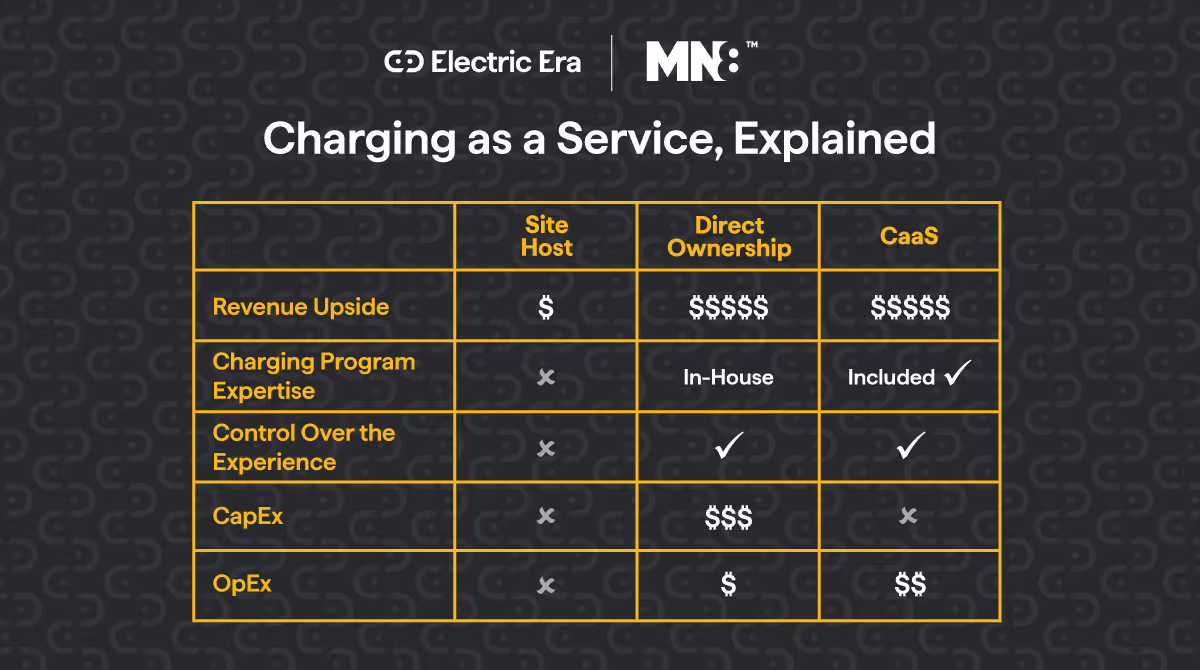
Charging as a Service (CaaS) is often described as “EV charging without CapEx.” That description is accurate, but incomplete. The real innovation is not financing—it is structural alignment.
At its core, CaaS is about allowing retailers to run EV charging like a strategic business unit while outsourcing the infrastructure burden to partners built for it.
What CaaS Actually Includes
Unlike simple leasing or revenue-share arrangements, a true CaaS model is end-to-end. It covers the entire lifecycle of an EV charging program:
- Portfolio-level strategy and rollout planning
- Site selection based on demand, power availability, and retail adjacency
- Upfront capital for hardware, construction, and grid interconnection
- Permitting, project management, and installation
- Ongoing network operations, monitoring, and maintenance
- Pricing strategy, analytics, and optimization
- Driver support and charger discoverability
- Full accountability for all of the above
From the retailer’s perspective, charging shows up as an operating expense tied to performance—not a capital project that must be justified years in advance.
The Key Distinction: Who Controls the Experience
The most important difference between our CaaS and legacy CPO models is control.
Under CaaS, the retailer:
- Sets charging prices
- Owns the on-screen experience
- Integrates their loyalty programs and promotions
- Captures 100% of charging revenue
- Uses charging as a channel to drive in-store conversion
- Uses charging to drive retail media network plays
The infrastructure partner owns and maintains the asset. The retailer owns the strategy and the customer. This distinction matters because EV charging is increasingly a brand touchpoint. The screen, the pricing logic, the reliability of the experience—all of it reflects back on the retailer and, in our model, the retailer stands to benefit economically inside and outside the store.
How Economics Shift Under CaaS
Instead of a large upfront investment, CaaS involves a fixed annual or monthly service fee, modeled to deliver a predictable return to the infrastructure owner. Pricing varies by site and portfolio, but the structure is consistent:
- Predictable costs
- No construction or hardware CapEx
- Retailer retains charging revenue
- Retailer captures downstream retail lift
This reframes EV charging from a capital allocation problem into an operating decision. The question becomes not “Can we afford to build this?” but “Does this outperform alternative uses of our parking lot and customer attention?”
Risk Reduction Without Strategic Compromise
CaaS also mitigates several categories of risk that have historically slowed enterprise adoption:
- Technology risk is borne by the infrastructure owner
- Operational risk is handled by teams already running large-scale energy assets
- Utilization risk can be addressed through portfolio modeling and, in some cases, utilization backstops
- Obsolescence risk is managed through upgrade paths at contract renewal
For retailers, this means faster time to market and less exposure to early-stage infrastructure volatility.
Not all “as-a-service” offerings are created equal
Retailers evaluating CaaS should scrutinize:
- Whether the charging hardware is designed for retail, not just vehicles
- Deployment timelines and grid mitigation strategies
- Reliability metrics at the port level
- Flexibility in pricing, branding, and software control
- Experience operating at portfolio scale
Stay tuned for future articles, where we will explore why pairing infrastructure ownership with retail-first charging technology matters—and how this combination enables a fundamentally different outcome than either approach alone.
This article was originally published on LinkedIn
Charging as a Service (CaaS) is often described as “EV charging without CapEx.” That description is accurate, but incomplete. The real innovation is not financing—it is structural alignment.
At its core, CaaS is about allowing retailers to run EV charging like a strategic business unit while outsourcing the infrastructure burden to partners built for it.
What CaaS Actually Includes
Unlike simple leasing or revenue-share arrangements, a true CaaS model is end-to-end. It covers the entire lifecycle of an EV charging program:
- Portfolio-level strategy and rollout planning
- Site selection based on demand, power availability, and retail adjacency
- Upfront capital for hardware, construction, and grid interconnection
- Permitting, project management, and installation
- Ongoing network operations, monitoring, and maintenance
- Pricing strategy, analytics, and optimization
- Driver support and charger discoverability
- Full accountability for all of the above
From the retailer’s perspective, charging shows up as an operating expense tied to performance—not a capital project that must be justified years in advance.
The Key Distinction: Who Controls the Experience
The most important difference between our CaaS and legacy CPO models is control.
Under CaaS, the retailer:
- Sets charging prices
- Owns the on-screen experience
- Integrates their loyalty programs and promotions
- Captures 100% of charging revenue
- Uses charging as a channel to drive in-store conversion
- Uses charging to drive retail media network plays
The infrastructure partner owns and maintains the asset. The retailer owns the strategy and the customer. This distinction matters because EV charging is increasingly a brand touchpoint. The screen, the pricing logic, the reliability of the experience—all of it reflects back on the retailer and, in our model, the retailer stands to benefit economically inside and outside the store.
How Economics Shift Under CaaS
Instead of a large upfront investment, CaaS involves a fixed annual or monthly service fee, modeled to deliver a predictable return to the infrastructure owner. Pricing varies by site and portfolio, but the structure is consistent:
- Predictable costs
- No construction or hardware CapEx
- Retailer retains charging revenue
- Retailer captures downstream retail lift
This reframes EV charging from a capital allocation problem into an operating decision. The question becomes not “Can we afford to build this?” but “Does this outperform alternative uses of our parking lot and customer attention?”
Risk Reduction Without Strategic Compromise
CaaS also mitigates several categories of risk that have historically slowed enterprise adoption:
- Technology risk is borne by the infrastructure owner
- Operational risk is handled by teams already running large-scale energy assets
- Utilization risk can be addressed through portfolio modeling and, in some cases, utilization backstops
- Obsolescence risk is managed through upgrade paths at contract renewal
For retailers, this means faster time to market and less exposure to early-stage infrastructure volatility.
Not all “as-a-service” offerings are created equal
Retailers evaluating CaaS should scrutinize:
- Whether the charging hardware is designed for retail, not just vehicles
- Deployment timelines and grid mitigation strategies
- Reliability metrics at the port level
- Flexibility in pricing, branding, and software control
- Experience operating at portfolio scale
Stay tuned for future articles, where we will explore why pairing infrastructure ownership with retail-first charging technology matters—and how this combination enables a fundamentally different outcome than either approach alone.