EV Fast Charging’s False Choice: Control or Capital



This article was originally published on LinkedIn
Today, the biggest retailers in the world are scaling up their EV fast charging strategies, getting a head start on shaping the next generation of refueling habits.
There are two main paths to scale, but for most retailers, each presents a frustrating dilemma. On one side is the traditional charge point operator (CPO) model: a third party installs, owns, and operates charging stations, paying the retailer a modest site-host fee. On the other side is full ownership: significant capital investment, internal team build-out, operational complexity, and long deployment timelines.
The industry has treated this as a binary choice. Either avoid CapEx and surrender control, or take on risk to access meaningful upside.
That framing is outdated.
As EV adoption accelerates and charging behavior matures, retailers are discovering that charging is not just an amenity—it is a strategic lever. It influences visit frequency, dwell time, loyalty engagement, and brand perception. Yet most existing charging deployments are structurally incapable of supporting those goals.
The problem is a mismatch between charging models and how retail actually works.
Why the CPO Model Falls Short
The CPO model was designed to scale infrastructure quickly, not to optimize retail outcomes. Under this approach, the operator controls pricing, branding, data, and the end-user experience. The retailer provides parking space and power access, and in return receives a fixed monthly fee.
This can be attractive early on. There is little upfront cost, minimal operational burden, and no internal expertise required. But the tradeoffs become clear over time:
- The charging experience is branded and priced by a third party, often misaligned with the retailer’s value proposition
- Customer data flows to the operator, not the retailer
- Loyalty programs, promotions, and omnichannel strategies stop at the store door
- Revenue upside is capped, regardless of utilization growth or customer behavior
For retailers who view EV drivers as high-value customers—and charging as a lever to influence where and how those customers shop—this model quickly becomes limiting.
The Hidden Cost of Owning It Yourself
At the other extreme, some enterprises have pursued full ownership. They invest in charging hardware, grid upgrades, construction, software platforms, and ongoing operations. Owning it yourself unlocks full control and revenue benefits.
For retailers with the resources and ambition, owning their own network and integrating deeply into their retail technology stack/strategy is a great North Star ideal—but, in practice, it introduces a new class of challenges:
- Multi-year deployment timelines driven by utility constraints and permitting
- Ensuring high reliability and driver experience while juggling multiple vendors/points of failure
- Large upfront capital requirements competing with core retail investments
- Ongoing operational risk tied to uptime, maintenance, pricing strategy, and customer support
- The need to build and retain a specialized internal EV charging team
For many retailers—especially those managing thousands of locations—this approach scales risk faster than value.
It’s Time for a Third Path
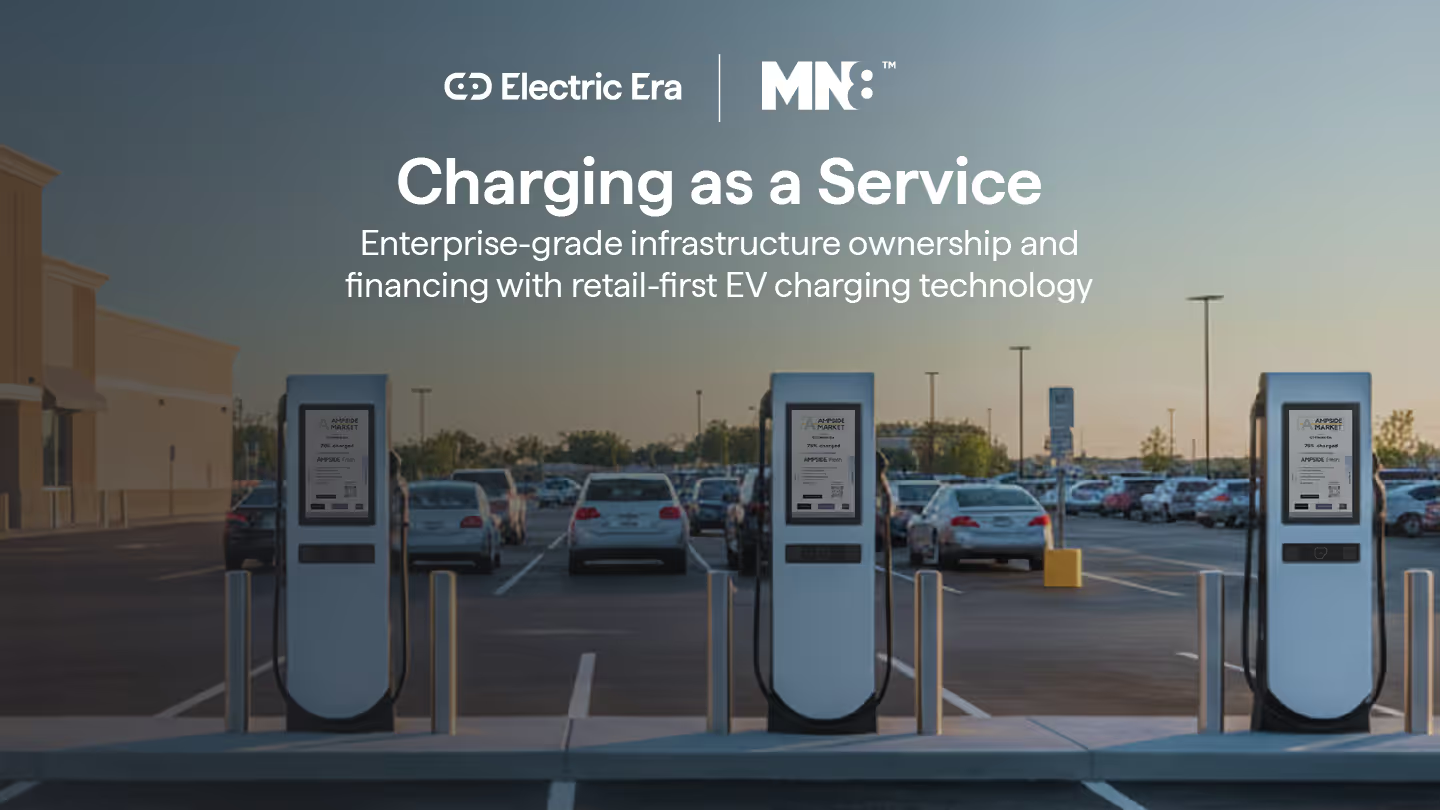
What has been missing is a model that decouples control from capital—which is why MN8 Energy and Electric Era are excited to introduce an integrated "Charging as a Service" (CaaS) model, combining enterprise-grade infrastructure ownership and financing with retail-first charging technology.
As EV charging strategies scale, it's become clear that retailers want to own the customer relationship, pricing strategy and experience. They want charging revenue and retail uplift with fast deployment and high reliability. But most do not want to become an infrastructure company.
This CaaS offering uniquely combines enterprise-grade infrastructure ownership and financing with retail-first charging technology. It allows retailers to operate EV charging as if it were an internal division, without building one from scratch or tying up capital. With this, it’s easier for retailers than ever to get serious about a retail-integrated EV charging program. Finally, they can meet rising customer demand with an option that aligns the economics and operating model.
In future articles, we’ll dive into how Charging as a Service works, why it changes the risk-reward equation, and what retailers should evaluate when considering this model.
To learn more about our joint CaaS offering, reach out to me or Alan on LinkedIn, or email sales@electricera.tech to schedule a meeting.
This article was originally published on LinkedIn
Today, the biggest retailers in the world are scaling up their EV fast charging strategies, getting a head start on shaping the next generation of refueling habits.
There are two main paths to scale, but for most retailers, each presents a frustrating dilemma. On one side is the traditional charge point operator (CPO) model: a third party installs, owns, and operates charging stations, paying the retailer a modest site-host fee. On the other side is full ownership: significant capital investment, internal team build-out, operational complexity, and long deployment timelines.
The industry has treated this as a binary choice. Either avoid CapEx and surrender control, or take on risk to access meaningful upside.
That framing is outdated.
As EV adoption accelerates and charging behavior matures, retailers are discovering that charging is not just an amenity—it is a strategic lever. It influences visit frequency, dwell time, loyalty engagement, and brand perception. Yet most existing charging deployments are structurally incapable of supporting those goals.
The problem is a mismatch between charging models and how retail actually works.
Why the CPO Model Falls Short
The CPO model was designed to scale infrastructure quickly, not to optimize retail outcomes. Under this approach, the operator controls pricing, branding, data, and the end-user experience. The retailer provides parking space and power access, and in return receives a fixed monthly fee.
This can be attractive early on. There is little upfront cost, minimal operational burden, and no internal expertise required. But the tradeoffs become clear over time:
- The charging experience is branded and priced by a third party, often misaligned with the retailer’s value proposition
- Customer data flows to the operator, not the retailer
- Loyalty programs, promotions, and omnichannel strategies stop at the store door
- Revenue upside is capped, regardless of utilization growth or customer behavior
For retailers who view EV drivers as high-value customers—and charging as a lever to influence where and how those customers shop—this model quickly becomes limiting.
The Hidden Cost of Owning It Yourself
At the other extreme, some enterprises have pursued full ownership. They invest in charging hardware, grid upgrades, construction, software platforms, and ongoing operations. Owning it yourself unlocks full control and revenue benefits.
For retailers with the resources and ambition, owning their own network and integrating deeply into their retail technology stack/strategy is a great North Star ideal—but, in practice, it introduces a new class of challenges:
- Multi-year deployment timelines driven by utility constraints and permitting
- Ensuring high reliability and driver experience while juggling multiple vendors/points of failure
- Large upfront capital requirements competing with core retail investments
- Ongoing operational risk tied to uptime, maintenance, pricing strategy, and customer support
- The need to build and retain a specialized internal EV charging team
For many retailers—especially those managing thousands of locations—this approach scales risk faster than value.
It’s Time for a Third Path
What has been missing is a model that decouples control from capital—which is why MN8 Energy and Electric Era are excited to introduce an integrated "Charging as a Service" (CaaS) model, combining enterprise-grade infrastructure ownership and financing with retail-first charging technology.
As EV charging strategies scale, it's become clear that retailers want to own the customer relationship, pricing strategy and experience. They want charging revenue and retail uplift with fast deployment and high reliability. But most do not want to become an infrastructure company.
This CaaS offering uniquely combines enterprise-grade infrastructure ownership and financing with retail-first charging technology. It allows retailers to operate EV charging as if it were an internal division, without building one from scratch or tying up capital. With this, it’s easier for retailers than ever to get serious about a retail-integrated EV charging program. Finally, they can meet rising customer demand with an option that aligns the economics and operating model.
In future articles, we’ll dive into how Charging as a Service works, why it changes the risk-reward equation, and what retailers should evaluate when considering this model.
To learn more about our joint CaaS offering, reach out to me or Alan on LinkedIn, or email sales@electricera.tech to schedule a meeting.