Why $/kW is the EV charging price metric that matters


Most EV charging evaluations are still being decided on price per port. For program leaders who have spent time with the underlying economics, that's a problem—not because the number is irrelevant, but because it's incomplete in a way that systematically produces the wrong answer.
Price per port captures what you're spending. It says nothing about what you're buying. And in a category where nameplate capacity varies by 2x or more between product tiers, letting cost-per-port anchor the conversation means the higher-performing product loses on a metric that doesn't measure performance.
The organizations who care about throughput and are building EV programs that will still make sense in 2030 are evaluating based on dollars per kilowatt. It's a small methodological shift with significant capital implications.
The problem with price per port
Comparing EV charging infrastructure on cost per port is like comparing trucks by sticker price without looking at payload capacity—the cheaper option looks better right up until it doesn't do the job.
Port count tells you how many vehicles can connect simultaneously. It says nothing about how fast those vehicles charge, how much energy moves through the system in a day, or whether that infrastructure will still be relevant when the next generation of EVs hits the road.
For many retailers looking to invest in EV charging infrastructure, that throughput is a critical component. If your goal is to get customers in and out of your store in 20-30 minutes, what you look for in an EV charging solution is going to be different than if you’re targeting 40+ minutes.
What the numbers actually show
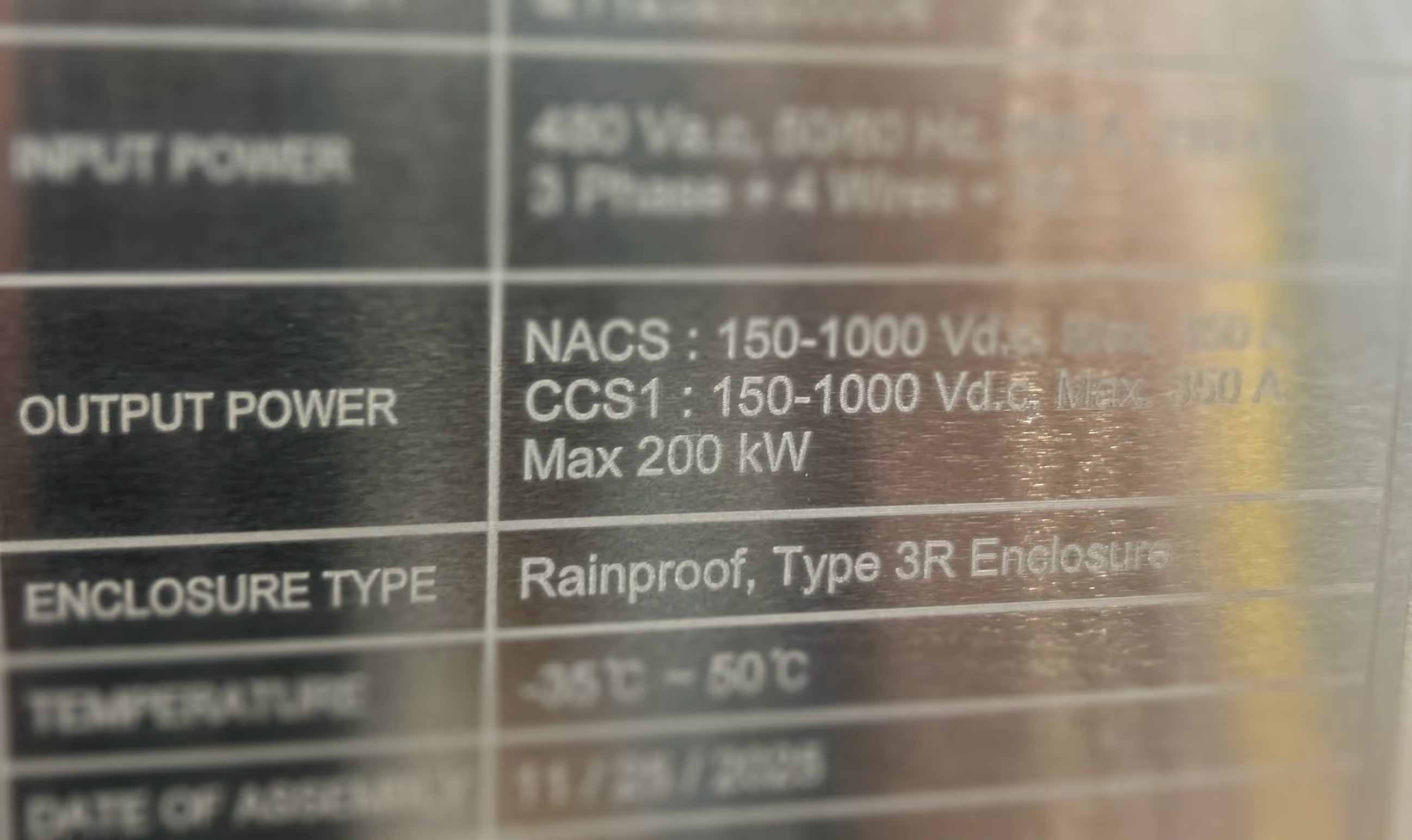
Take an 8-port configuration as an example. Let’s say an average 8-port station with 200 kW dispensers averages $450k—that’s $281 per kW (nameplate). On the other hand, an 8-port station with 400 kW dispensers averages $650k. That price sounds like a premium until you calculate $203 per kW (nameplate). A 28% cost advantage for the higher-power product.
The product that looks like a premium is actually the better value—once you're measuring the right thing.
Why power capacity translates to business value
This isn't just financial engineering. The kW advantage has direct operational consequences.
Faster charging means more cars served. A station with 400 kW dispensers can move twice the energy in the same window as 200 kW dispensers. At peak hours—weekends, evenings, holiday travel—that throughput difference is the difference between getting 100 customers through your store versus 50 customers. It’s not just twice the charging revenue; it’s all the additional in-store revenue from more foot traffic.
Premium charging attracts premium drivers. EV adoption is no longer confined to early adopters. The mainstream EV buyer today has their expectations set by the fastest charger (often nameplate) they've ever seen. Showing up with lower-power infrastructure signals that EV charging is an afterthought, not an amenity.
Higher power is a brand signal. The retailers winning on EV experience aren't the ones with the most ports—they're the ones whose chargers work fast, work reliably, and feel like they belong at a modern retail location.
Infrastructure is a silent communicator of brand standards.
The futureproofing argument
The EV market is not static, and the vehicles on the road today are not the vehicles that will dominate your lot in four years.
Current EVs are increasingly capable of accepting higher charge rates. Newer models from nearly every major manufacturer are shipping with larger battery packs and higher acceptance rates. Infrastructure that feels adequate today will feel underpowered by the time your retail footprint has fully built out—and the cost of retrofitting, including permitting, construction, and downtime, is not a line item most EV program leaders want to justify to their CFO twice.
Investing in 400 kW nameplate capacity now means your infrastructure grows into the market rather than chasing it. That's standard capital planning logic applied to a category that moves faster than most.
Reframing the internal conversation
For EV program leaders, the challenge is often less about knowing the right answer and more about translating it for the people who control the budget. "It's a better product" doesn't survive a capital review. When throughput and capacity are a priority, "It's 24% less expensive per kW of capacity, and here's why kW is the right denominator" does.
The $/kW framing does three things in that conversation. It shifts the conversation from price to value. It introduces a durable evaluation metric that holds up across vendors and product configurations. And it shifts the frame from "how much are we spending" to "how much charging capacity are we buying"—which is the question that actually predicts long-term performance.
That reframe is worth bringing into your evaluations. Consider analyzing solutions on a $/kW nameplate basis alongside total cost.
The bottom line
Price per port is a purchasing shortcut that produces suboptimal infrastructure decisions. Dollars per kilowatt of nameplate capacity is the metric that reflects what EV charging infrastructure actually delivers—power, throughput, speed, and relevance over time.
The RE400 is a premium product by one measure. By the measure that matters, it's the most cost-efficient path to building an EV charging program that performs today and scales into the market that's coming.
Bring the right metric into your evaluation. The numbers will do the rest.
Most EV charging evaluations are still being decided on price per port. For program leaders who have spent time with the underlying economics, that's a problem—not because the number is irrelevant, but because it's incomplete in a way that systematically produces the wrong answer.
Price per port captures what you're spending. It says nothing about what you're buying. And in a category where nameplate capacity varies by 2x or more between product tiers, letting cost-per-port anchor the conversation means the higher-performing product loses on a metric that doesn't measure performance.
The organizations who care about throughput and are building EV programs that will still make sense in 2030 are evaluating based on dollars per kilowatt. It's a small methodological shift with significant capital implications.
The problem with price per port
Comparing EV charging infrastructure on cost per port is like comparing trucks by sticker price without looking at payload capacity—the cheaper option looks better right up until it doesn't do the job.
Port count tells you how many vehicles can connect simultaneously. It says nothing about how fast those vehicles charge, how much energy moves through the system in a day, or whether that infrastructure will still be relevant when the next generation of EVs hits the road.
For many retailers looking to invest in EV charging infrastructure, that throughput is a critical component. If your goal is to get customers in and out of your store in 20-30 minutes, what you look for in an EV charging solution is going to be different than if you’re targeting 40+ minutes.
What the numbers actually show
Take an 8-port configuration as an example. Let’s say an average 8-port station with 200 kW dispensers averages $450k—that’s $281 per kW (nameplate). On the other hand, an 8-port station with 400 kW dispensers averages $650k. That price sounds like a premium until you calculate $203 per kW (nameplate). A 28% cost advantage for the higher-power product.
The product that looks like a premium is actually the better value—once you're measuring the right thing.
Why power capacity translates to business value
This isn't just financial engineering. The kW advantage has direct operational consequences.
Faster charging means more cars served. A station with 400 kW dispensers can move twice the energy in the same window as 200 kW dispensers. At peak hours—weekends, evenings, holiday travel—that throughput difference is the difference between getting 100 customers through your store versus 50 customers. It’s not just twice the charging revenue; it’s all the additional in-store revenue from more foot traffic.
Premium charging attracts premium drivers. EV adoption is no longer confined to early adopters. The mainstream EV buyer today has their expectations set by the fastest charger (often nameplate) they've ever seen. Showing up with lower-power infrastructure signals that EV charging is an afterthought, not an amenity.
Higher power is a brand signal. The retailers winning on EV experience aren't the ones with the most ports—they're the ones whose chargers work fast, work reliably, and feel like they belong at a modern retail location.
Infrastructure is a silent communicator of brand standards.
The futureproofing argument
The EV market is not static, and the vehicles on the road today are not the vehicles that will dominate your lot in four years.
Current EVs are increasingly capable of accepting higher charge rates. Newer models from nearly every major manufacturer are shipping with larger battery packs and higher acceptance rates. Infrastructure that feels adequate today will feel underpowered by the time your retail footprint has fully built out—and the cost of retrofitting, including permitting, construction, and downtime, is not a line item most EV program leaders want to justify to their CFO twice.
Investing in 400 kW nameplate capacity now means your infrastructure grows into the market rather than chasing it. That's standard capital planning logic applied to a category that moves faster than most.
Reframing the internal conversation
For EV program leaders, the challenge is often less about knowing the right answer and more about translating it for the people who control the budget. "It's a better product" doesn't survive a capital review. When throughput and capacity are a priority, "It's 24% less expensive per kW of capacity, and here's why kW is the right denominator" does.
The $/kW framing does three things in that conversation. It shifts the conversation from price to value. It introduces a durable evaluation metric that holds up across vendors and product configurations. And it shifts the frame from "how much are we spending" to "how much charging capacity are we buying"—which is the question that actually predicts long-term performance.
That reframe is worth bringing into your evaluations. Consider analyzing solutions on a $/kW nameplate basis alongside total cost.
The bottom line
Price per port is a purchasing shortcut that produces suboptimal infrastructure decisions. Dollars per kilowatt of nameplate capacity is the metric that reflects what EV charging infrastructure actually delivers—power, throughput, speed, and relevance over time.
The RE400 is a premium product by one measure. By the measure that matters, it's the most cost-efficient path to building an EV charging program that performs today and scales into the market that's coming.
Bring the right metric into your evaluation. The numbers will do the rest.