Case Study | How SkyCharger built the first energized site in Washington’s WAEVCP program at the A1 Gas & Food Mart in Arlington, WA



Goals:
- Build a fast, reliable EV charging station in a charging desert
- Increase revenue and foot traffic to local business
Implementation:
- WAEVCP Round 1 grant recipient
- 4 dual-port 200 kW chargers
- Energized in 8 months
Electric Era took 100% responsibility for the project, managing over 110 hours of grant and project implementation work.
Results:
- Stood up a critical EV charging station on a 141-mile "charging desert" at the gateway to the North Cascades
- 85.6% first shot reliability
- 99.8% uptime
- Charging EVs on a 130 MWh per year pace
- 26 minute average dwell time
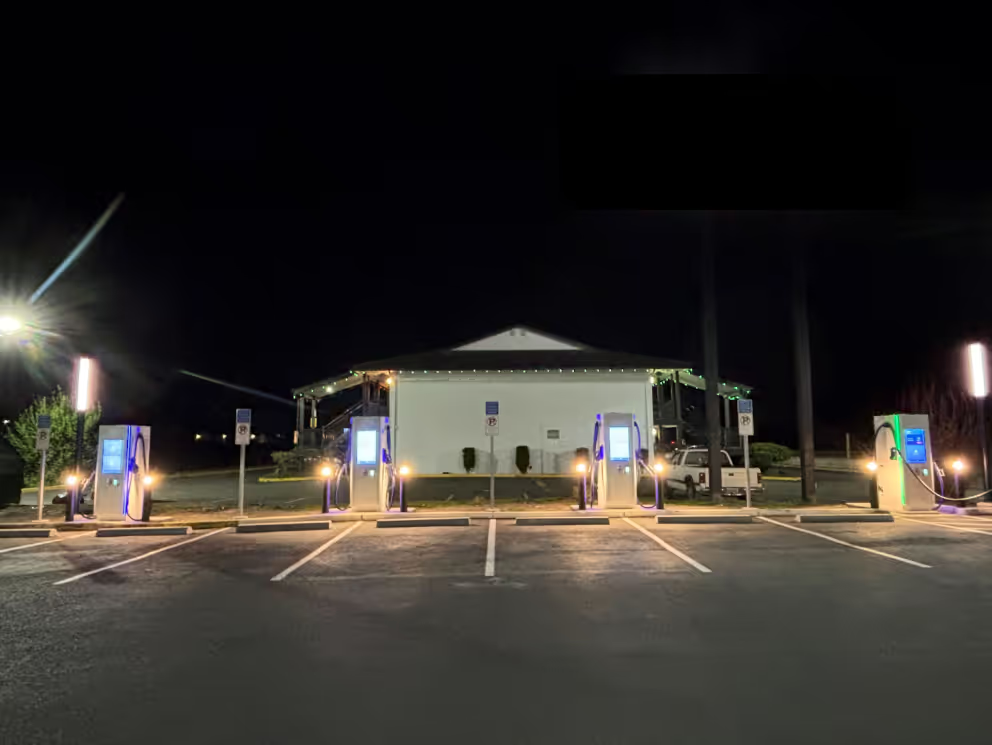
This project in Arlington, WA includes a host of stakeholders including SkyCharger (the site owner), A1 Gas and Food Mart (fuel retailer and c-store), the Washington State Department of Commerce, and the Snohomish Public Utility District.
This station filled a critical gap for EV drivers in the Pacific Northwest:
- Filling in a key 141-mile corridor between the Greater Seattle Region and the Canada border, and the only 150+ kW EV charger between Marysville and Mount Vernon, a 25+ mile stretch of the I-5.
- It’s also strategically located at the “gateway to the North Cascades”, the intersection of I-5 and SR 530 which stretches from Mt. Baker-Snoqualmie National Forest to North Cascades National Park and beyond.
In partnership with Skycharger, who is building out a West Coast network of reliable EV charging access for both passenger and commercial EVs, Electric Era identified A1 Gas and Food Mart as an excellent site host location for fast charging. In addition to its location at the intersection of two highways, it is a 24/7 fuel retailer with lighting, bathrooms, and a delicious taco truck.
In all, Electric Era worked to manage the various interests and reporting requirements of these diverse stakeholders, ranging from government agencies to private developers.

The challenge:
Deploying EV infrastructure involves a daunting amount of bureaucratic red tape, including complex permitting, utility interconnection, and utilization uncertainty. Navigating government procurement policies, complex corridor requirements, and multi-layered permitting processes are all things that can stall a project before it even breaks ground. Securing a connection involves determining specific rate classes, coordinating grid updates, and managing the technical approval of battery-integrated hardware.
Meeting the specific requirements of grant programs can amplify these challenges. This grant— Washington EV Charging Program (WAEVCP) Round 1, comprising nearly $100M awarded to install more than 5,000 charging ports—stipulates a strict 545-day deadline (approximately 1.5 years) to use the awarded funds. Meeting this window proved to be so difficult that most projects in Round 1 were forced to request extensions, leading the state legislature to reduce funding for subsequent rounds due to a perceived lack of efficiency.
Trouble arises:
Once the project won funding, the city of Arlington instituted a development moratorium, pausing all new building permits (even for projects in existing retail lots) to plan for land use changes triggered by the Link Light Rail extension. Even though the station was being added to an existing retailer's parking lot, it required a new building permit that was effectively blocked by this legislation. This, obviously, threatened to be a major roadblock.
Electric Era steps in:
Unlike "off the shelf" products that require the owner to find their own development services, this project utilized a "one-stop shop" model that handled every technical and legal hurdle for the customer. Electric Era’s government affairs team managed 30 hours of grant application work, and the implementation team spent over 80 hours navigating site design, engineering, and construction challenges including archaic utility processes for grid connection.
To solve the (all too common) technical delay of getting a new transformer to be able to deliver the power required for high speed charging, Electric Era turned to its patented battery-backed technology. This was praised by the local utility, Snohomish PUD, as this approach allowed them to avoid building costly grid upgrades and reduced overall transmission costs.
To solve the political roadblock, Electric Era engaged directly with the mayor and participated in city council meetings to lobby for an amendment, successfully convincing the council to add a unanimous carve-out to the moratorium specifically for EV charging at existing retail locations. After only two months, work was allowed to resume.
Results: a win-win-win-win
Electrifying this site is a success for all parties involved: EV drivers, A1 (site host), Skycharger (site operator), Washington Department of Commerce and the City of Arlington/SnoPUD.
This station brings fast, reliable EV charging complete with ample amenities to serve EV drivers in this part of the state. Connecting this stretch of the I-5 means it's now possible for EV roadtrippers to travel from Vancouver, BC to the California Bay Area using exclusively Electric Era charging stations.

With an 8-month total time to site opening, the Arlington site successfully opened as the first station to go live in the entire WAEVCP program. To commemorate this success, state officials joined Skycharger, A1, and Electric Era in a ribbon-cutting. While many other Round 1 projects were forced to ask for extensions on their 545-day deadline, this project demonstrated Electric Era’s ability to move quickly. Electric Era’s average implementation timeline of 6 to 8 months, compared to an industry average of 1-2 years, means site operators and hosts get to profitability faster, and grant programs more effectively turn public money into real-world impact.
Electric Era’s battery-backed EV charging technology is not only fast and reliable, it’s also good for utilities, and as a result, the local residents and businesses too, in an increasingly power-constrained environment. “The project’s use of innovative battery technology made it possible to provide power to the chargers without the need for increased capacity or expensive upgrades,” said Aaron Swaney, Snohomish Public Utility District. “We’re thrilled that Electric Era will help us support EV customers in our service area with minimal impact on our residential and business customers.”
Beyond securing government funding, Electric Era provides customers with immediate, tangible data to prove the investment's worth. The station is pacing to deliver 115+ MWh per year (electrifying about 450,000 miles of driving) with 85.6% first shot session success and 99.8% uptime—resulting in a 10/10 Plugshare score. For A-1, drivers spend an average of 26 minutes charging, meaning more in-store and taco truck purchases, too.
Finally, this success has provided the state legislature with the confidence to continue funding programs that support EV charging infrastructure, ensuring future dollars remain available for small businesses.
Electric Era works hard on behalf of our customers. Our innovative product, end-to-end services, and expertise enables us to help site owners and operators capitalize on grants, skillfully navigate challenges, and get high-performing sites built fast, maximizing profitability.
Together, let's deploy more EV charging infrastructure that accelerates EV adoption, exceptional business outcomes for you and your site, and the future of transportation in general.
Ready to start? Schedule a call with us.

--
About the Climate Commitment Act
The Washington State Department of Commerce's Electric Vehicle Charging Program is supported with funding from Washington's Climate Commitment Act. The CCA supports Washington's climate action efforts by putting cap-and-invest dollars to work reducing climate pollution, creating jobs, and improving public health. Information about the CCA is available at www.climate.wa.gov.
Goals:
- Build a fast, reliable EV charging station in a charging desert
- Increase revenue and foot traffic to local business
Implementation:
- WAEVCP Round 1 grant recipient
- 4 dual-port 200 kW chargers
- Energized in 8 months
Electric Era took 100% responsibility for the project, managing over 110 hours of grant and project implementation work.
Results:
- Stood up a critical EV charging station on a 141-mile "charging desert" at the gateway to the North Cascades
- 85.6% first shot reliability
- 99.8% uptime
- Charging EVs on a 130 MWh per year pace
- 26 minute average dwell time
This project in Arlington, WA includes a host of stakeholders including SkyCharger (the site owner), A1 Gas and Food Mart (fuel retailer and c-store), the Washington State Department of Commerce, and the Snohomish Public Utility District.
This station filled a critical gap for EV drivers in the Pacific Northwest:
- Filling in a key 141-mile corridor between the Greater Seattle Region and the Canada border, and the only 150+ kW EV charger between Marysville and Mount Vernon, a 25+ mile stretch of the I-5.
- It’s also strategically located at the “gateway to the North Cascades”, the intersection of I-5 and SR 530 which stretches from Mt. Baker-Snoqualmie National Forest to North Cascades National Park and beyond.
In partnership with Skycharger, who is building out a West Coast network of reliable EV charging access for both passenger and commercial EVs, Electric Era identified A1 Gas and Food Mart as an excellent site host location for fast charging. In addition to its location at the intersection of two highways, it is a 24/7 fuel retailer with lighting, bathrooms, and a delicious taco truck.
In all, Electric Era worked to manage the various interests and reporting requirements of these diverse stakeholders, ranging from government agencies to private developers.
The challenge:
Deploying EV infrastructure involves a daunting amount of bureaucratic red tape, including complex permitting, utility interconnection, and utilization uncertainty. Navigating government procurement policies, complex corridor requirements, and multi-layered permitting processes are all things that can stall a project before it even breaks ground. Securing a connection involves determining specific rate classes, coordinating grid updates, and managing the technical approval of battery-integrated hardware.
Meeting the specific requirements of grant programs can amplify these challenges. This grant— Washington EV Charging Program (WAEVCP) Round 1, comprising nearly $100M awarded to install more than 5,000 charging ports—stipulates a strict 545-day deadline (approximately 1.5 years) to use the awarded funds. Meeting this window proved to be so difficult that most projects in Round 1 were forced to request extensions, leading the state legislature to reduce funding for subsequent rounds due to a perceived lack of efficiency.
Trouble arises:
Once the project won funding, the city of Arlington instituted a development moratorium, pausing all new building permits (even for projects in existing retail lots) to plan for land use changes triggered by the Link Light Rail extension. Even though the station was being added to an existing retailer's parking lot, it required a new building permit that was effectively blocked by this legislation. This, obviously, threatened to be a major roadblock.
Electric Era steps in:
Unlike "off the shelf" products that require the owner to find their own development services, this project utilized a "one-stop shop" model that handled every technical and legal hurdle for the customer. Electric Era’s government affairs team managed 30 hours of grant application work, and the implementation team spent over 80 hours navigating site design, engineering, and construction challenges including archaic utility processes for grid connection.
To solve the (all too common) technical delay of getting a new transformer to be able to deliver the power required for high speed charging, Electric Era turned to its patented battery-backed technology. This was praised by the local utility, Snohomish PUD, as this approach allowed them to avoid building costly grid upgrades and reduced overall transmission costs.
To solve the political roadblock, Electric Era engaged directly with the mayor and participated in city council meetings to lobby for an amendment, successfully convincing the council to add a unanimous carve-out to the moratorium specifically for EV charging at existing retail locations. After only two months, work was allowed to resume.
Results: a win-win-win-win
Electrifying this site is a success for all parties involved: EV drivers, A1 (site host), Skycharger (site operator), Washington Department of Commerce and the City of Arlington/SnoPUD.
This station brings fast, reliable EV charging complete with ample amenities to serve EV drivers in this part of the state. Connecting this stretch of the I-5 means it's now possible for EV roadtrippers to travel from Vancouver, BC to the California Bay Area using exclusively Electric Era charging stations.
With an 8-month total time to site opening, the Arlington site successfully opened as the first station to go live in the entire WAEVCP program. To commemorate this success, state officials joined Skycharger, A1, and Electric Era in a ribbon-cutting. While many other Round 1 projects were forced to ask for extensions on their 545-day deadline, this project demonstrated Electric Era’s ability to move quickly. Electric Era’s average implementation timeline of 6 to 8 months, compared to an industry average of 1-2 years, means site operators and hosts get to profitability faster, and grant programs more effectively turn public money into real-world impact.
Electric Era’s battery-backed EV charging technology is not only fast and reliable, it’s also good for utilities, and as a result, the local residents and businesses too, in an increasingly power-constrained environment. “The project’s use of innovative battery technology made it possible to provide power to the chargers without the need for increased capacity or expensive upgrades,” said Aaron Swaney, Snohomish Public Utility District. “We’re thrilled that Electric Era will help us support EV customers in our service area with minimal impact on our residential and business customers.”
Beyond securing government funding, Electric Era provides customers with immediate, tangible data to prove the investment's worth. The station is pacing to deliver 115+ MWh per year (electrifying about 450,000 miles of driving) with 85.6% first shot session success and 99.8% uptime—resulting in a 10/10 Plugshare score. For A-1, drivers spend an average of 26 minutes charging, meaning more in-store and taco truck purchases, too.
Finally, this success has provided the state legislature with the confidence to continue funding programs that support EV charging infrastructure, ensuring future dollars remain available for small businesses.
Electric Era works hard on behalf of our customers. Our innovative product, end-to-end services, and expertise enables us to help site owners and operators capitalize on grants, skillfully navigate challenges, and get high-performing sites built fast, maximizing profitability.
Together, let's deploy more EV charging infrastructure that accelerates EV adoption, exceptional business outcomes for you and your site, and the future of transportation in general.
Ready to start? Schedule a call with us.
--
About the Climate Commitment Act
The Washington State Department of Commerce's Electric Vehicle Charging Program is supported with funding from Washington's Climate Commitment Act. The CCA supports Washington's climate action efforts by putting cap-and-invest dollars to work reducing climate pollution, creating jobs, and improving public health. Information about the CCA is available at www.climate.wa.gov.