The cost to operate public EV charging in California’s largest IOUs



Utility rates are one of the biggest considerations when considering ownership of a public EV fast charger in California. Failure to manage how your charger draws electricity at peak times can result in bills upwards of tens of thousands of dollars.
Why utility rates matter for EV fast charging
When people talk about the cost of EV fast charging, they usually focus on equipment, construction, or grid upgrades. But one of the most important and least intuitive operational cost drivers is utility rate design.
For commercial EV charging, especially high-power DC fast charging, demand charges and subscription-based rates can quickly dominate operating costs. A single peak demand event can drive thousands of dollars in monthly charges, even if it lasts only minutes. In California, where electricity prices are already high, these effects are amplified.
Let’s look at how the three largest investor-owned utilities (IOUs) – Southern California Edison (SCE), San Diego Gas & Electric (SDG&E), and Pacific Gas & Electric (PG&E) structure their rates. This is critical to building long-term financially sustainable charging infrastructure in the state.
A Quick Refresher: Energy vs. Demand
Commercial electricity bills generally include:
- Energy charges, based on total electricity consumed (kWh)
- Demand charges, based on the highest level of power draw (kW) during a billing period
Fast chargers draw large amounts of power in short bursts, making them especially vulnerable to demand charges. Here is an example of this from a local business owner in Idaho:
"We just got our first power bill for our new tesla superchargers & we’re in trouble. Our chargers averaged 164 kW this mo. After the first 20 kW, the utility charges $8 per kW. That’s $1,152/month in demand feels alone - before paying for a single kwh of actual electricity." - Isaac French, local business owner
To address this, utilities have introduced EV-specific rates that delay, reduce, or restructure how demand costs are applied, with very different results across California. Mr. French contines to write that, "if all four of our chargers ran at full power, the demand fee alone would be $10,400/month."
PG&E: Rewarding predictability
PG&E’s Business EV Rate (BEV2) replaces traditional demand charges with a subscription-based kW allocation. It applies to commercial EV installations of 100 kW and above, including public fast-charging stations.
What the program entails:
- Customers select a kW subscription level
- Each 50 kW increment costs $95.56 (about $1.91 per kW)
- Overage fees, billed at double the normal per-kW rate, apply if usage exceeds that level
To keep operating costs predictable under PG&E’s BEV rate, you must stay within your subscribed power limit to avoid overage fees. Electric Era’s intelligent load management helps keep station demand within that limit, reducing exposure to unexpected utility charges.
Bottom line:
In PG&E territory, the base subscription is cheap, but extra fees and power limits can ruin a project's budget and long-term costs.
Southern California Edison: Long-term impact
In Southern California, SCE currently offers several commercial EV rates – EV-TOU-7, EV-TOU-8, and EV-TOU-9 – that remain energy-only, with no demand charges until the end of 2029.
This creates short-term certainty for fast-charging projects, but a few years in, demand charges will return to stations, creating a lurch in station economics. SCE has indicated that demand charges are likely to return beginning January 1, 2030.
Bottom line:
SCE’s rates are suitable for near-term deployment, but long-lived assets should plan for future exposure to demand charges in the 2030s.
SDG&E: High risk, high cost subscription pricing
SDG&E’s EV-HP (Electric Vehicle - High Power) rate uses a subscription-based model instead of traditional demand charges. Customers select a maximum kW subscription level in 25 kW increments and must keep their demand below that threshold to avoid additional costs.
Beginning in 2025, SDG&E started phasing out EV-specific discounts, gradually increasing both distribution and energy charges. By January 1, 2032, the discount will disappear completely, and charging a vehicle will cost the same as standard commercial electricity. As of January 1, 2026, the EV-HP subscription price for loads above 150 kW is $164.90 per 25 kW (about $6.60 per kW).
To put this into perspective, a NEVI-compliant station capable of delivering 150 kW to four vehicles simultaneously would require 600 kW of grid capacity, or just 350 kW with Electric Era’s battery-backed design:
The financial impact is substantial. For a high-power charging site:
- 600 kW grid subscription: ~$47,500 per year
- 350 kW grid subscription: ~$27,700 per year
That’s nearly $20,000 in annual savings from managing peak grid draw, and those savings will grow as subscription prices increase.
Additionally, for stations served under this SDG&E model, OpEx certainty depends on predictability. Electric Era’s intelligent load management brings greater control over peak station demand, ensuring sites operate within their subscription and avoid unplanned OpEx costs
Bottom line:
SDG&E strongly rewards demand predictability and control. Long-term operating risk increases as EV discounts phase out.
What This Means for EV Charging in California
Across all three IOUs, the trend is clear: rate design creates risk for customers who can’t control peak demand.
For charging station operators, being sophisticated about station demand, system sizing, and operational controls can save tens of thousands of dollars each year throughout the life of a charging site. As California scales its EV infrastructure, understanding and planning for utility rate risk will be just as important as building chargers themselves.
Want more?
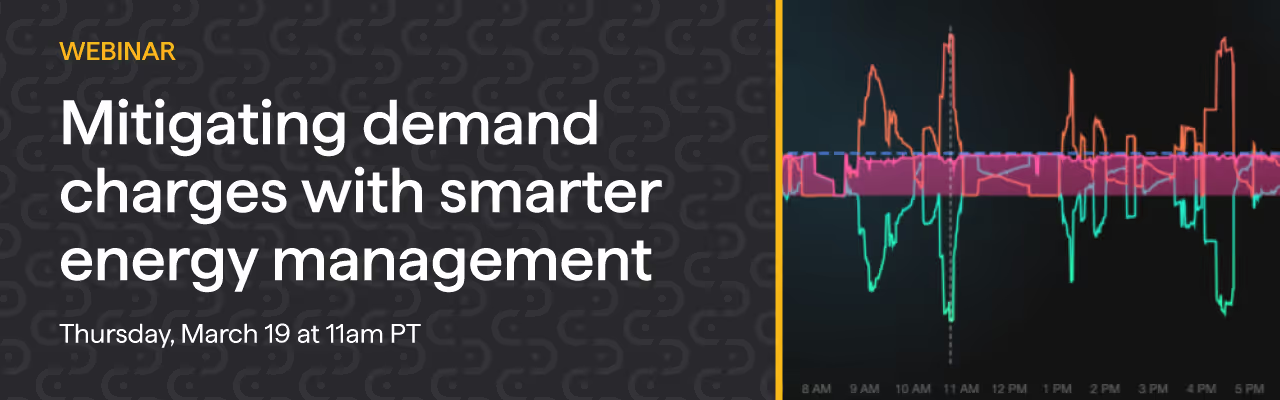
Join our webinar on Mitigating demand charges with smarter energy management. We will dive deep into technical approaches and share some success stories (including saving one site $15,000/quarter in demand charges), helping you:
- Understand the different tariff and demand charge structures
- Look around corners for planning your station
- Rethink whether you can deploy charging at a site you previously thought was uneconomical

Not sure where to start?
Book time with us. Our team of experts can walk you through these specific examples and other government and utility details that will help you understand EV fast charging in your area.
Utility rates are one of the biggest considerations when considering ownership of a public EV fast charger in California. Failure to manage how your charger draws electricity at peak times can result in bills upwards of tens of thousands of dollars.
Why utility rates matter for EV fast charging
When people talk about the cost of EV fast charging, they usually focus on equipment, construction, or grid upgrades. But one of the most important and least intuitive operational cost drivers is utility rate design.
For commercial EV charging, especially high-power DC fast charging, demand charges and subscription-based rates can quickly dominate operating costs. A single peak demand event can drive thousands of dollars in monthly charges, even if it lasts only minutes. In California, where electricity prices are already high, these effects are amplified.
Let’s look at how the three largest investor-owned utilities (IOUs) – Southern California Edison (SCE), San Diego Gas & Electric (SDG&E), and Pacific Gas & Electric (PG&E) structure their rates. This is critical to building long-term financially sustainable charging infrastructure in the state.
A Quick Refresher: Energy vs. Demand
Commercial electricity bills generally include:
- Energy charges, based on total electricity consumed (kWh)
- Demand charges, based on the highest level of power draw (kW) during a billing period
Fast chargers draw large amounts of power in short bursts, making them especially vulnerable to demand charges. Here is an example of this from a local business owner in Idaho:
"We just got our first power bill for our new tesla superchargers & we’re in trouble. Our chargers averaged 164 kW this mo. After the first 20 kW, the utility charges $8 per kW. That’s $1,152/month in demand feels alone - before paying for a single kwh of actual electricity." - Isaac French, local business owner
To address this, utilities have introduced EV-specific rates that delay, reduce, or restructure how demand costs are applied, with very different results across California. Mr. French contines to write that, "if all four of our chargers ran at full power, the demand fee alone would be $10,400/month."
PG&E: Rewarding predictability
PG&E’s Business EV Rate (BEV2) replaces traditional demand charges with a subscription-based kW allocation. It applies to commercial EV installations of 100 kW and above, including public fast-charging stations.
What the program entails:
- Customers select a kW subscription level
- Each 50 kW increment costs $95.56 (about $1.91 per kW)
- Overage fees, billed at double the normal per-kW rate, apply if usage exceeds that level
To keep operating costs predictable under PG&E’s BEV rate, you must stay within your subscribed power limit to avoid overage fees. Electric Era’s intelligent load management helps keep station demand within that limit, reducing exposure to unexpected utility charges.
Bottom line:
In PG&E territory, the base subscription is cheap, but extra fees and power limits can ruin a project's budget and long-term costs.
Southern California Edison: Long-term impact
In Southern California, SCE currently offers several commercial EV rates – EV-TOU-7, EV-TOU-8, and EV-TOU-9 – that remain energy-only, with no demand charges until the end of 2029.
This creates short-term certainty for fast-charging projects, but a few years in, demand charges will return to stations, creating a lurch in station economics. SCE has indicated that demand charges are likely to return beginning January 1, 2030.
Bottom line:
SCE’s rates are suitable for near-term deployment, but long-lived assets should plan for future exposure to demand charges in the 2030s.
SDG&E: High risk, high cost subscription pricing
SDG&E’s EV-HP (Electric Vehicle - High Power) rate uses a subscription-based model instead of traditional demand charges. Customers select a maximum kW subscription level in 25 kW increments and must keep their demand below that threshold to avoid additional costs.
Beginning in 2025, SDG&E started phasing out EV-specific discounts, gradually increasing both distribution and energy charges. By January 1, 2032, the discount will disappear completely, and charging a vehicle will cost the same as standard commercial electricity. As of January 1, 2026, the EV-HP subscription price for loads above 150 kW is $164.90 per 25 kW (about $6.60 per kW).
To put this into perspective, a NEVI-compliant station capable of delivering 150 kW to four vehicles simultaneously would require 600 kW of grid capacity, or just 350 kW with Electric Era’s battery-backed design:
The financial impact is substantial. For a high-power charging site:
- 600 kW grid subscription: ~$47,500 per year
- 350 kW grid subscription: ~$27,700 per year
That’s nearly $20,000 in annual savings from managing peak grid draw, and those savings will grow as subscription prices increase.
Additionally, for stations served under this SDG&E model, OpEx certainty depends on predictability. Electric Era’s intelligent load management brings greater control over peak station demand, ensuring sites operate within their subscription and avoid unplanned OpEx costs
Bottom line:
SDG&E strongly rewards demand predictability and control. Long-term operating risk increases as EV discounts phase out.
What This Means for EV Charging in California
Across all three IOUs, the trend is clear: rate design creates risk for customers who can’t control peak demand.
For charging station operators, being sophisticated about station demand, system sizing, and operational controls can save tens of thousands of dollars each year throughout the life of a charging site. As California scales its EV infrastructure, understanding and planning for utility rate risk will be just as important as building chargers themselves.
Want more?
Join our webinar on Mitigating demand charges with smarter energy management. We will dive deep into technical approaches and share some success stories (including saving one site $15,000/quarter in demand charges), helping you:
- Understand the different tariff and demand charge structures
- Look around corners for planning your station
- Rethink whether you can deploy charging at a site you previously thought was uneconomical
Not sure where to start?
Book time with us. Our team of experts can walk you through these specific examples and other government and utility details that will help you understand EV fast charging in your area.