Power in months, not years: Connecting ahead of the queue with CoPower


In my last post I introduced grid augmentation: a behind-the-meter battery and real-time controls software that deliver power above your grid connection limit, uprating sellable compute by 15-40%. That post was about the utility capacity you already have. This one is about achieving utility interconnection at all, years before the queue would otherwise let you.
The premise is simple: the slowest part of building a data center is waiting for power.
The queue is the competitor
For an AI data center today, land and capital are solvable. Power is not. The average interconnection request now takes close to five years to reach commercial operation, up from under two in 2008. Some California projects have stretched past nine years. ERCOT's large-load queue grew nearly 300% in a single year. The grid did not get slower; demand arrived faster than electric utilities can move.
Every month in that queue is a month of GPUs not bought, tenants not signed, and compute not sold. Where demand compounds quarterly, a three-year delay is the difference between leading a market and missing it, rather than just a scheduling inconvenience.
Utilities are opening a faster door
Faced with the same backlog, utilities have started offering a faster path for flexible loads. Rather than sizing your service for the worst hour of the worst day, and making you wait for the required upgrades, they offer the capacity available now, in exchange for pulling back during a handful of constrained peak hours.
These programs are expanding rapidly. PG&E's Flex Connect lets data centers connect where their full capacity would otherwise be denied, in exchange for honoring day-ahead hourly limits. SPP's proposed Conditional High Impact Large Load Service (CHILLS) service offers large loads a 90-day interconnection study and conditional service for one to five years. PJM is moving toward non-firm transmission service for loads that accept curtailment ahead of firm load, and Texas SB6 now mandates curtailment protocols for new large loads above 75 MW. The common thread: accept some flexibility, skip years of waiting for network upgrades.
There is a catch, and it is why most data centers can't walk through this door.
Why most data centers can't take the deal
A flexible agreement asks you to cut consumption during specific hours on the utility's signal. An EV fast charger or industrial site can throttle back; an AI data center cannot. Tenants contract for "four nines" (99.99% uptime), so a megawatt of inference curtailed on an August peak afternoon is revenue lost and an SLA breached. The flexibility the utility needs and the reliability the tenant demands are irreconcilable.
This is exactly the gap that grid augmentation closes.
A worked example: honoring the limit without curtailing a single GPU
Picture a 20 MW site applying for service in a constrained part of the grid. The utility responds the way they increasingly do: full firm capacity is years out, but you can energize now under a flexible agreement if you hold your draw below a day-ahead limit during roughly 80-150 peak hours a year.
Without a battery and advanced controls, that offer is unusable: you'd throttle compute during exactly the hours your tenants are paying for it. With CoPower, you accept the agreement and let the battery absorb the obligation.
Each constrained hour, the utility sends a day-ahead limit. Our platform reads it and discharges the battery to cover the gap between what the grid allows and what the facility is drawing. To the utility, the site sits under its limit. To the tenant, every GPU runs at full tilt. The flexibility lives in the battery, not the compute.
It's the same store-and-deliver mechanism we run across our EV charging fleet, where we've augmented 564 MWh in the last six months and demonstrated up to 70% delivery above a grid limit—now sized to a data center's load profile and backed by up to a 99.99% availability guarantee.
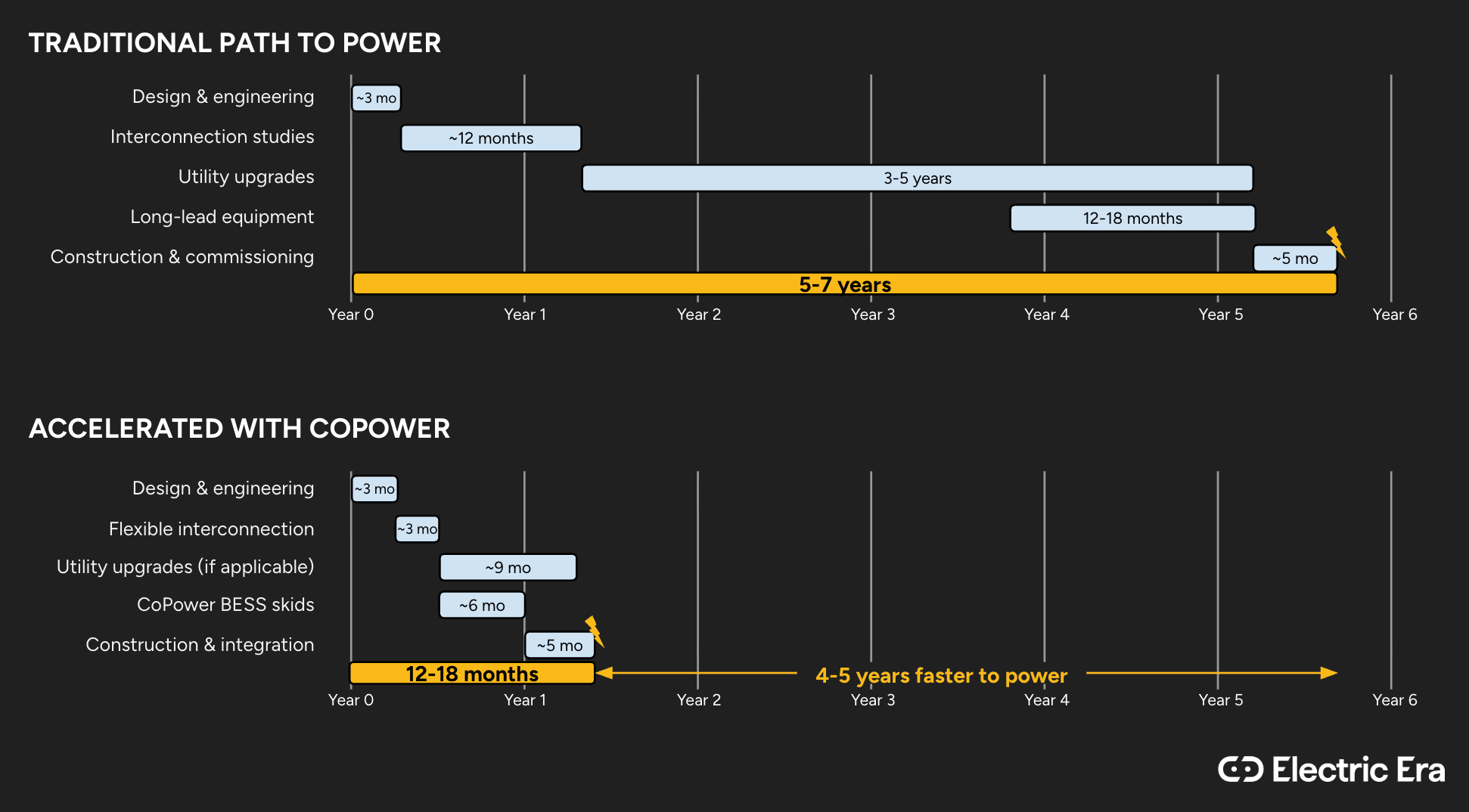
The result is a site energized in months rather than years, with no compromise on uptime.
What the wait actually costs
The economics of a data center are directly impacted by the timeline. That same 20 MW connection carries roughly 15 MW of IT load, and at the ~$15M per MW a neocloud monetizes each year, that's on the order of $230M of compute annually. Energize two years ahead of where the queue would have placed you, and you've captured roughly $460M of revenue otherwise deferred, before counting the tenants you can sign because you had power when competitors did not. Time-to-power is no longer an engineering footnote. For neoclouds, it is the dominant variable in the return. Similar gains are realized with CoLos too.
Grid augmentation turns a utility's flexibility requirement from a dealbreaker into a door. The capacity is available now, on terms utilities are actively offering, and the battery is what lets a data center say yes without ever dimming a rack.
Next, the other half of the reliability story: holding power quality steady, voltage, frequency, and ride-through, on a battery-augmented site at the megawatt class. After that: connecting in a tightening regulatory landscape, including Texas SB6 and the rules following it.
Onwards,
Quincy
Interested in learning more? Let's scope your site.
In my last post I introduced grid augmentation: a behind-the-meter battery and real-time controls software that deliver power above your grid connection limit, uprating sellable compute by 15-40%. That post was about the utility capacity you already have. This one is about achieving utility interconnection at all, years before the queue would otherwise let you.
The premise is simple: the slowest part of building a data center is waiting for power.
The queue is the competitor
For an AI data center today, land and capital are solvable. Power is not. The average interconnection request now takes close to five years to reach commercial operation, up from under two in 2008. Some California projects have stretched past nine years. ERCOT's large-load queue grew nearly 300% in a single year. The grid did not get slower; demand arrived faster than electric utilities can move.
Every month in that queue is a month of GPUs not bought, tenants not signed, and compute not sold. Where demand compounds quarterly, a three-year delay is the difference between leading a market and missing it, rather than just a scheduling inconvenience.
Utilities are opening a faster door
Faced with the same backlog, utilities have started offering a faster path for flexible loads. Rather than sizing your service for the worst hour of the worst day, and making you wait for the required upgrades, they offer the capacity available now, in exchange for pulling back during a handful of constrained peak hours.
These programs are expanding rapidly. PG&E's Flex Connect lets data centers connect where their full capacity would otherwise be denied, in exchange for honoring day-ahead hourly limits. SPP's proposed Conditional High Impact Large Load Service (CHILLS) service offers large loads a 90-day interconnection study and conditional service for one to five years. PJM is moving toward non-firm transmission service for loads that accept curtailment ahead of firm load, and Texas SB6 now mandates curtailment protocols for new large loads above 75 MW. The common thread: accept some flexibility, skip years of waiting for network upgrades.
There is a catch, and it is why most data centers can't walk through this door.
Why most data centers can't take the deal
A flexible agreement asks you to cut consumption during specific hours on the utility's signal. An EV fast charger or industrial site can throttle back; an AI data center cannot. Tenants contract for "four nines" (99.99% uptime), so a megawatt of inference curtailed on an August peak afternoon is revenue lost and an SLA breached. The flexibility the utility needs and the reliability the tenant demands are irreconcilable.
This is exactly the gap that grid augmentation closes.
A worked example: honoring the limit without curtailing a single GPU
Picture a 20 MW site applying for service in a constrained part of the grid. The utility responds the way they increasingly do: full firm capacity is years out, but you can energize now under a flexible agreement if you hold your draw below a day-ahead limit during roughly 80-150 peak hours a year.
Without a battery and advanced controls, that offer is unusable: you'd throttle compute during exactly the hours your tenants are paying for it. With CoPower, you accept the agreement and let the battery absorb the obligation.
Each constrained hour, the utility sends a day-ahead limit. Our platform reads it and discharges the battery to cover the gap between what the grid allows and what the facility is drawing. To the utility, the site sits under its limit. To the tenant, every GPU runs at full tilt. The flexibility lives in the battery, not the compute.
It's the same store-and-deliver mechanism we run across our EV charging fleet, where we've augmented 564 MWh in the last six months and demonstrated up to 70% delivery above a grid limit—now sized to a data center's load profile and backed by up to a 99.99% availability guarantee.
The result is a site energized in months rather than years, with no compromise on uptime.
What the wait actually costs
The economics of a data center are directly impacted by the timeline. That same 20 MW connection carries roughly 15 MW of IT load, and at the ~$15M per MW a neocloud monetizes each year, that's on the order of $230M of compute annually. Energize two years ahead of where the queue would have placed you, and you've captured roughly $460M of revenue otherwise deferred, before counting the tenants you can sign because you had power when competitors did not. Time-to-power is no longer an engineering footnote. For neoclouds, it is the dominant variable in the return. Similar gains are realized with CoLos too.
Grid augmentation turns a utility's flexibility requirement from a dealbreaker into a door. The capacity is available now, on terms utilities are actively offering, and the battery is what lets a data center say yes without ever dimming a rack.
Next, the other half of the reliability story: holding power quality steady, voltage, frequency, and ride-through, on a battery-augmented site at the megawatt class. After that: connecting in a tightening regulatory landscape, including Texas SB6 and the rules following it.
Onwards,
Quincy
Interested in learning more? Let's scope your site.