Below 75 MW: The Fastest Path to Power While Texas Pauses Batch Zero


TL;DR –
- ERCOT released guidance last week delaying the first Batch Zero transmission planning study; projects qualifying as Large Loads (greater than 75 MW) will have interconnection timelines extended indefinitely.
- Projects less than 75 MW are not the target of this ruling and can actually be accelerated to interconnection by registering as a Curtailable Load Resource (CLR).
- Serving as a CLR can accelerate time to power to as little as 12 months, but it requires a battery energy storage system (BESS) designed for utility planning requirements.
Background
On August 3, Texas Governor Greg Abbott ordered an audit of every data center in ERCOT's interconnection queue.The queue grew to roughly 474 GW of requests, which is about five times the state's record peak demand, with data centers making up an estimated 90 percent of it. In response, ERCOT delayed its first Batch Zero transmission planning study, the review process covering the first cohort of projects under the state's new Large Load Interconnection framework.
ERCOT defines a Large Load as projects requesting greater than 75 MW at a single site. Large Loads are studied in groups every six months by the local Transmission and Distribution Utility (TDU) and approved by ERCOT. As a result of this order, data centers that qualify as a Large Load will see energization timelines extended indefinitely.
In the meantime, projects under 75 MW are not subject to ERCOT’s Batch Zero process; the local TDU runs the end-to-end interconnection process. It’s a lighter process with the potential to accelerate further (~12 months) when the facility registers as a Curtailable Load Resources (CLR), a classification which allows the utility to see the data center load as flexible and curtailable during operation. As a non-wires alternative, it also typically reduces the developer-borne cost of interconnection (i.e. the “Contribution in Aid of Construction”, or CIAC) – and avoids potential negative impacts of price increases to the rate payer.
Battery storage as a curtailable load resource
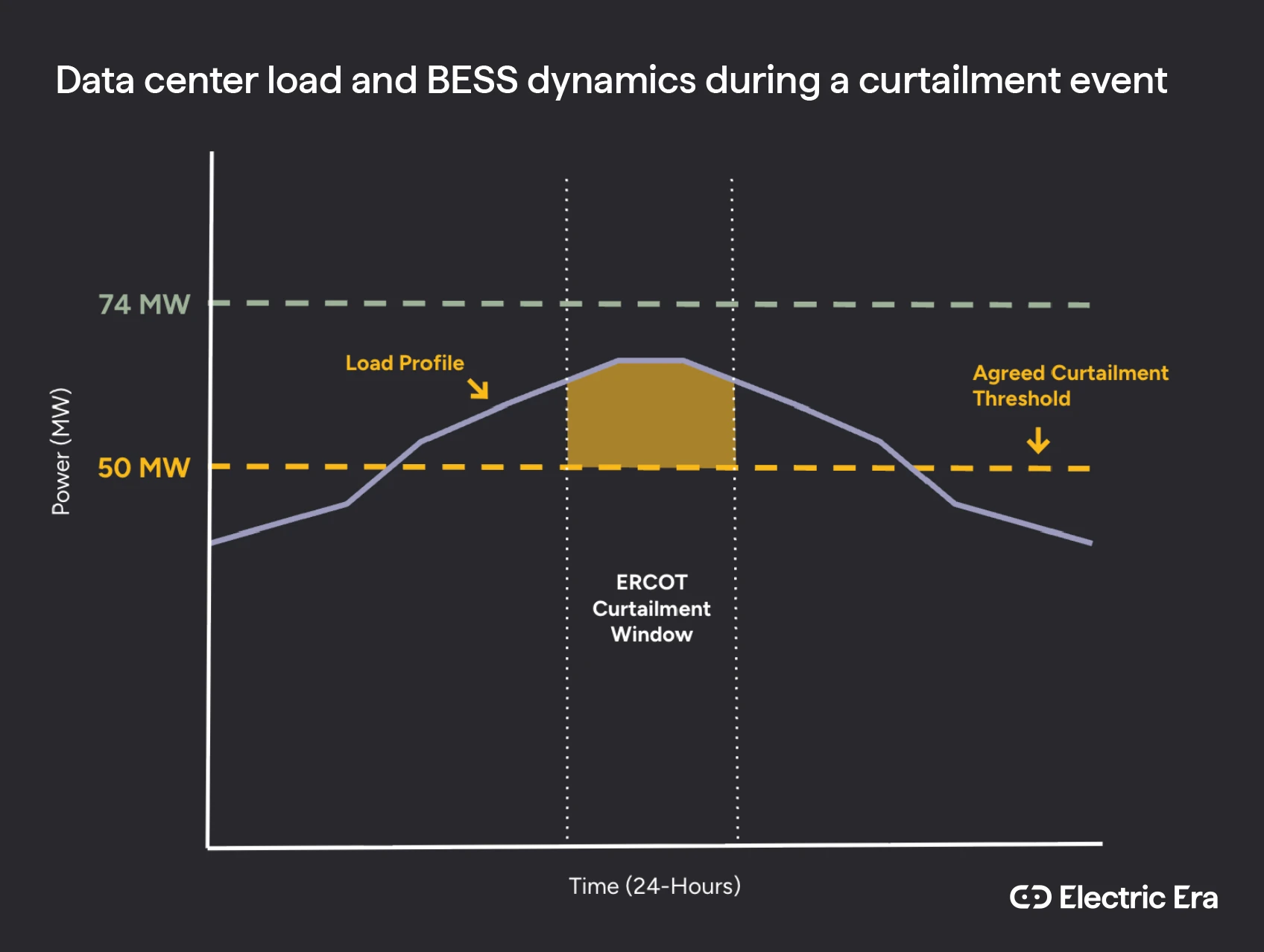
As a CLR, the data center’s full load doesn’t have to be curtailed; you can use appropriately-sized BESS to respond, when called by ERCOT, by discharging during specific windows. During these windows, your IT Load and Facility Load remain constant, supported by the BESS, while the utility sees the agreed-upon reduction in load.
With this flexibility, the TDU models the lower threshold during the interconnection process, which means (in many cases) no wire upgrades. This is where the reduction of time-to-power happens, bringing a project in from multiple years to as little as 12 months. Meanwhile, your tenants see no change in their contracted load. See an illustration below, detailing the data center load and BESS dynamics during a curtailment event.
What the sub-75 MW path actually looks like
The Transmission and Distribution Utility (TDU) process is a five-step sequence, and it runs on an independent schedule:
- Pre-screen and apply. Bring the TDU the site location, requested demand, service voltage, and in-service date, and file the load, commercial, and industrial application: one-line diagram, drawings, and load characteristics. At this stage, it’s important to include the BESS, as the flexible resource, in the planning process to avoid the need to re-apply later on. It’s important to select a partner who can model available withdrawal capacity against utility-mandated contingency cases to size the BESS correctly from the beginning.
- Kickoff meeting. Meet the TDU's planning, engineering, metering, and operations groups directly.
- Impact study, typically 6 to 8 weeks. The TDU sizes the facility, its loads, and its generators, running capacity planning under contingency cases alongside dynamic transient modeling for stability. This is where the BESS is evaluated as a non-wires alternative and the associated time-to-power advantage is known.
- Agreements and build. Scope, cost, and schedule get finalized, security is posted, and the TDU builds and coordinates any required grid upgrades.
- Energize. Metering is installed, service is activated, and the site clears witness testing.
Speed you can plan around
As a result of this news, Batch Zero projects now see an uncertain horizon when it comes to time to power. Meanwhile, sub-75 MW projects built around a right-sized BESS and intelligence software can reliably get you power in 12-18 months by designing and operating as a curtailable load resource.
With this option, you can sign new customers and generate revenue while the bigger projects sit idle in the queue. Electric Era is here to help you navigate this process as an end-to-end solutions provider — everything from utility coordination, engineering/design, implementation, hardware and software to operations as a curtailable load resource, we have you covered. Let’s get your compute online faster.
Interested in learning more? Let's scope your site.
TL;DR –
- ERCOT released guidance last week delaying the first Batch Zero transmission planning study; projects qualifying as Large Loads (greater than 75 MW) will have interconnection timelines extended indefinitely.
- Projects less than 75 MW are not the target of this ruling and can actually be accelerated to interconnection by registering as a Curtailable Load Resource (CLR).
- Serving as a CLR can accelerate time to power to as little as 12 months, but it requires a battery energy storage system (BESS) designed for utility planning requirements.
Background
On August 3, Texas Governor Greg Abbott ordered an audit of every data center in ERCOT's interconnection queue.The queue grew to roughly 474 GW of requests, which is about five times the state's record peak demand, with data centers making up an estimated 90 percent of it. In response, ERCOT delayed its first Batch Zero transmission planning study, the review process covering the first cohort of projects under the state's new Large Load Interconnection framework.
ERCOT defines a Large Load as projects requesting greater than 75 MW at a single site. Large Loads are studied in groups every six months by the local Transmission and Distribution Utility (TDU) and approved by ERCOT. As a result of this order, data centers that qualify as a Large Load will see energization timelines extended indefinitely.
In the meantime, projects under 75 MW are not subject to ERCOT’s Batch Zero process; the local TDU runs the end-to-end interconnection process. It’s a lighter process with the potential to accelerate further (~12 months) when the facility registers as a Curtailable Load Resources (CLR), a classification which allows the utility to see the data center load as flexible and curtailable during operation. As a non-wires alternative, it also typically reduces the developer-borne cost of interconnection (i.e. the “Contribution in Aid of Construction”, or CIAC) – and avoids potential negative impacts of price increases to the rate payer.
Battery storage as a curtailable load resource
As a CLR, the data center’s full load doesn’t have to be curtailed; you can use appropriately-sized BESS to respond, when called by ERCOT, by discharging during specific windows. During these windows, your IT Load and Facility Load remain constant, supported by the BESS, while the utility sees the agreed-upon reduction in load.
With this flexibility, the TDU models the lower threshold during the interconnection process, which means (in many cases) no wire upgrades. This is where the reduction of time-to-power happens, bringing a project in from multiple years to as little as 12 months. Meanwhile, your tenants see no change in their contracted load. See an illustration below, detailing the data center load and BESS dynamics during a curtailment event.
What the sub-75 MW path actually looks like
The Transmission and Distribution Utility (TDU) process is a five-step sequence, and it runs on an independent schedule:
- Pre-screen and apply. Bring the TDU the site location, requested demand, service voltage, and in-service date, and file the load, commercial, and industrial application: one-line diagram, drawings, and load characteristics. At this stage, it’s important to include the BESS, as the flexible resource, in the planning process to avoid the need to re-apply later on. It’s important to select a partner who can model available withdrawal capacity against utility-mandated contingency cases to size the BESS correctly from the beginning.
- Kickoff meeting. Meet the TDU's planning, engineering, metering, and operations groups directly.
- Impact study, typically 6 to 8 weeks. The TDU sizes the facility, its loads, and its generators, running capacity planning under contingency cases alongside dynamic transient modeling for stability. This is where the BESS is evaluated as a non-wires alternative and the associated time-to-power advantage is known.
- Agreements and build. Scope, cost, and schedule get finalized, security is posted, and the TDU builds and coordinates any required grid upgrades.
- Energize. Metering is installed, service is activated, and the site clears witness testing.
Speed you can plan around
As a result of this news, Batch Zero projects now see an uncertain horizon when it comes to time to power. Meanwhile, sub-75 MW projects built around a right-sized BESS and intelligence software can reliably get you power in 12-18 months by designing and operating as a curtailable load resource.
With this option, you can sign new customers and generate revenue while the bigger projects sit idle in the queue. Electric Era is here to help you navigate this process as an end-to-end solutions provider — everything from utility coordination, engineering/design, implementation, hardware and software to operations as a curtailable load resource, we have you covered. Let’s get your compute online faster.
Interested in learning more? Let's scope your site.