Autonomy-first software for power infrastructure: Inside CoPower's 99.99% availability guarantee


TL;DR
- Current State: Legacy BESS solutions typically quote 97–99% availability on product spec sheets; these are not financially or contractually guaranteed commitments but aspirational targets or (best case) historical performance.
- It is no secret that achieving high asset availability in practice is challenging. It requires vigilant oversight and network operations, rapid troubleshooting and decision-making, and efficient technician field work.
- While legacy BESS solutions leverage people-dependent network operations, the next frontier of asset availability will be led by software-first network operations capable of making rapid, telemetry-informed decisions autonomously, leveraging humans in the loop only to perform software hot-fixes and informed field dispatch.
- Electric Era delivers up to 99.99% guaranteed availability on the CoPower Platform; this is achieved via an autonomy-first software-driven platform and redundant BESS capacity in reserve, delivering the certainty data center developers and operators require.
Background: availability is the ceiling on everything else
At a high level, batteries are deployed at data centers to manage power quality, perform tariff optimization, participate in grid services, and accelerate time to market via flexible interconnection. These are great outcomes but, with existing solutions, all of these capabilities and objectives are capped by asset performance.
At 97-99% availability, legacy BESS solutions see significant asset downtime – up to 11 days per year. These are days you cannot exercise the battery to avoid 4CP days (tariff optimization) or respond to your utility-contracted curtailment windows (flexible interconnection). These are just two examples of many that can significantly impact economics and customer compute curtailment.
At 99.99%, the same table-stakes functionality (and more, see our power augmentation blog) are performed at vastly higher reliability; the battery is available day-in and day-out. Electric Era achieves industry-leading availability through two parallel pathways: 1) our autonomy-first, software-driven operations platform, and 2) BESS redundancy for additional layers of available capacity.
Ingredient #1: an autonomy-first software platform
The legacy operating model
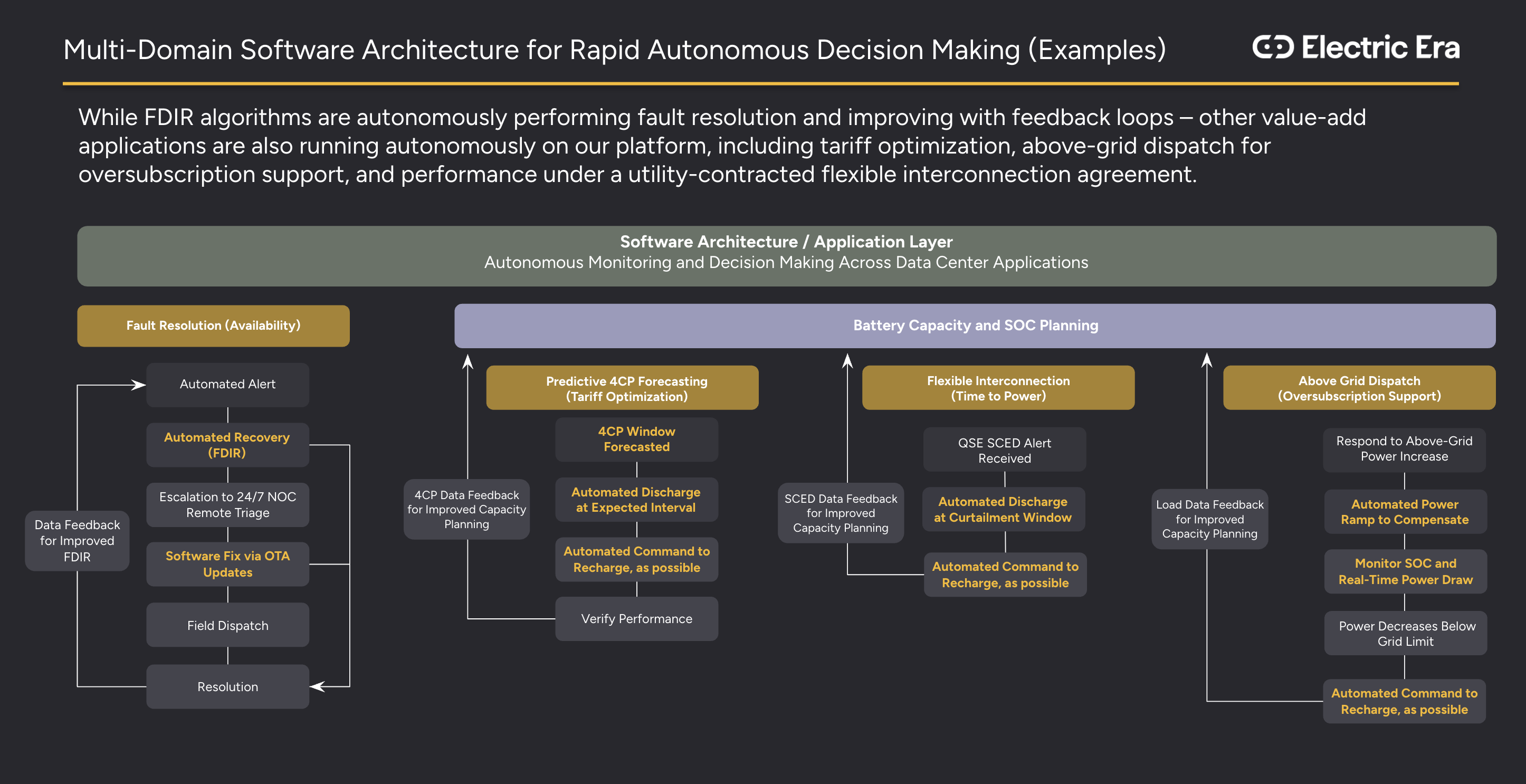
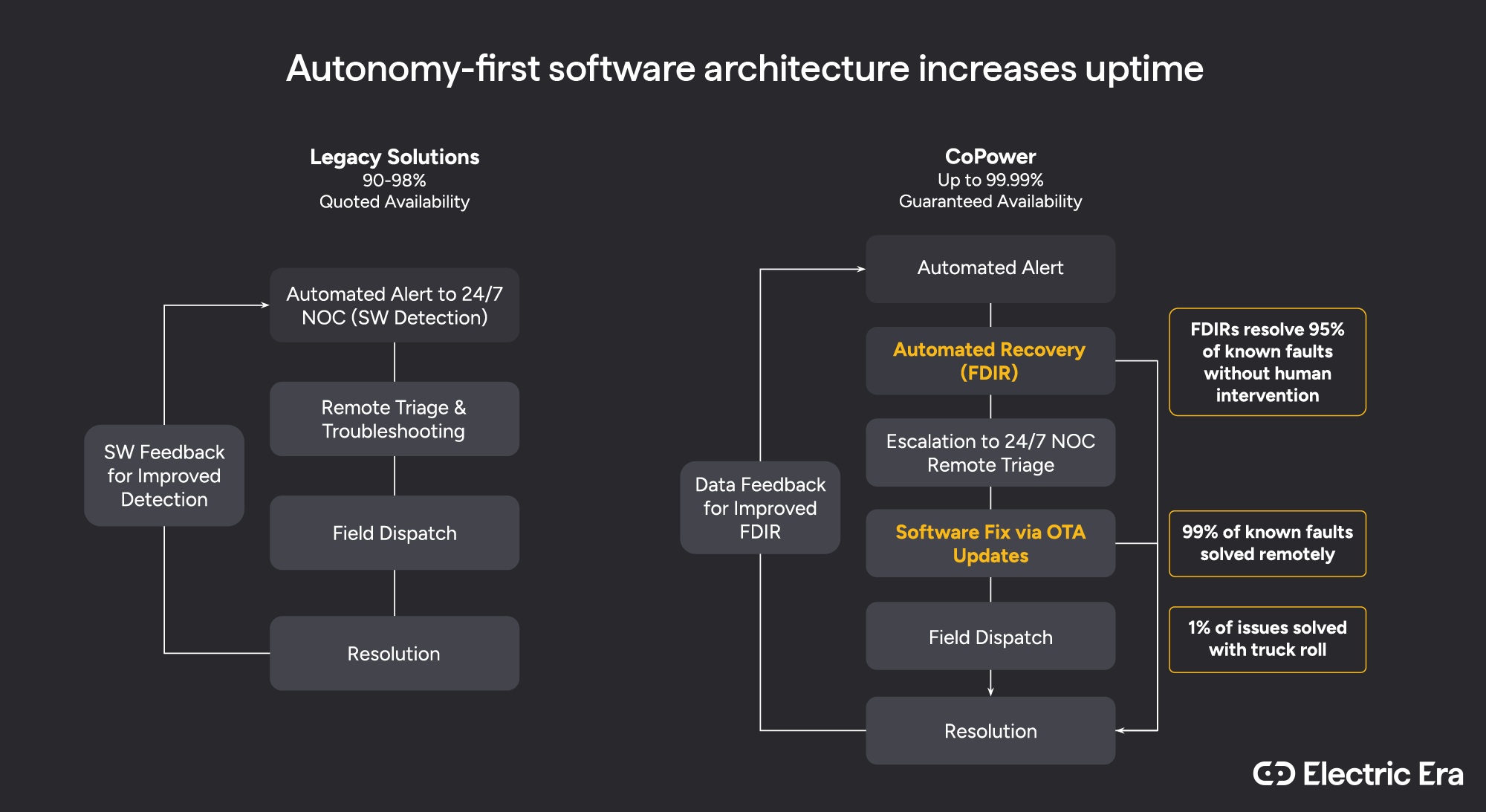
In short, legacy BESS solutions deliver supervisory systems to empower human observability and control — software is used primarily for fault detection. In this model, people are the first line of defense; they review telemetry, attempting to connect the dots and resolve the issue remotely. If not possible, they dispatch a technician to the site for issue diagnosis or in-field recovery. As a result, legacy operations centers are difficult to scale and struggle to continually improve availability beyond baseline performance. See the image below for the typical flow from alert to fault resolution (legacy solutions on the left-hand side).
The CoPower model
Electric Era’s approach views network operations as a software problem. The platform leverages a software-driven, autonomy-first framework. It’s scalable, more reliable, and makes smarter decisions faster.
When a fault occurs, the first line of defense is software. The platform leverages Fault Detection, Isolation, and Recovery (FDIRs) algorithms to rapidly and autonomously recover from known faults without human intervention, preventing downtime in real-time.
If not resolved by FDIR, the issue can typically be resolved via a software over-the-air (OTA) update via our 24/7 network operations center (NOC). This brings our prevention of issues to 99%. The final 1% of issues are solved by rolling a truck, and software and deep telemetry enable the lowest downtime possible. Technicians are dispatched to site with a diagnosis of the issue from Electric Era’s Network Operations Center and are prepared to fix the issue on their first visit.
What does all this require?
- Continuous shared state; all assets exchange real-time telemetry and events on a common bus.
- Deterministic energy control at the edge; real-time control loops; <3 ms power control response.
- Deep hardware integrations; access to and monitoring of real-time telemetry to build FDIR algorithsm to fix native OEM shortcomings
- Deep software-first feedback loops; data insights and retrospective analysis to strengthen performance via development of new FDIRs and operational improvements.
Ingredient #2: additional BESS capacity for redundancy
Electric Era’s autonomy-first, software-driven operations platform delivers industry-leading reliability by itself (99%+ availability). In order to achieve even higher levels of reliability, we deploy additional battery units in redundancy to ensure sufficient layers of overlapped capacity. If an inverter or battery goes down, a unit in reserve steps in to deliver the nominal nameplate capacity. The number of redundant units depends on two items: 1) baseline availability (how dependable are BESS units without redundancy), 2) the desired level of guaranteed availability (up to 99.99%).
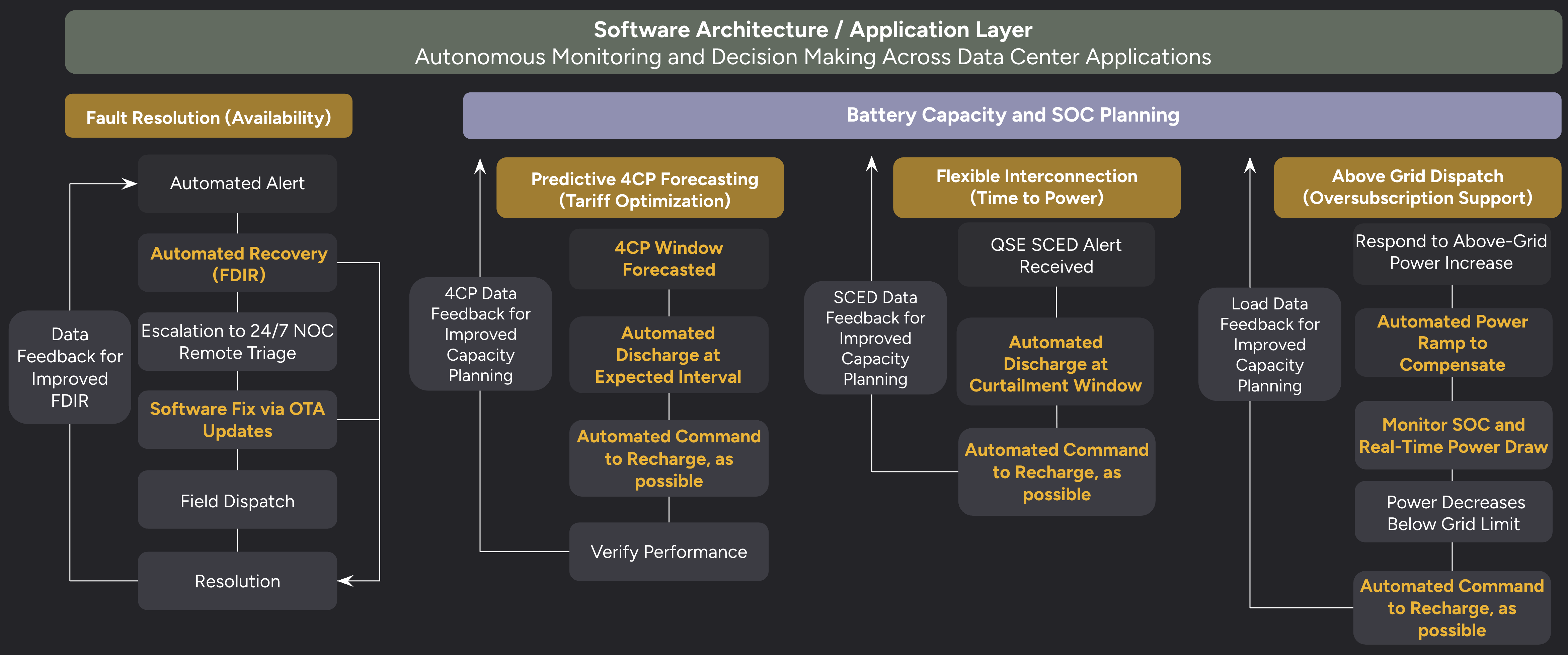
Availability/fault resolution is one of many applications being performed autonomously by our software platform at your data center. What else is happening?
While FDIR algorithms are autonomously performing fault resolution and improving with feedback loops – other value-add applications are also running autonomously on our platform, including tariff optimization, above-grid dispatch for oversubscription support, and performance under a utility-contracted flexible interconnection agreement. These are examples – exact applications running at your data center will depend on site characteristics, utility requirements, and your commercial objectives. Stay tuned for a future blog post on this subject.
Conclusion
In today’s energy landscape, it has never been more important to achieve high asset availability – data center developers and operators see continuous pressure from tenants, transmission and distribution utilities, the regional transmission offices, among others. Legacy BESS solutions communicate 97–99% availability (quoted, not guaranteed), leveraging people-dependent network operations that are not designed for scale and are not capable of achieving next-level availability, let alone guaranteeing it.
Achieving high availability is a technical challenge; autonomy-first, software-driven platforms and redundancy capacity are required to meet the level of high availability that data centers need for sustained growth, economic wins, and accelerated time to market.
Electric Era is ushering the industry into the next frontier – availability you can count on day-in and day-out, a proven software and operations architecture with ample run-time across three dozen projects across the country, achieving greater than 99% availability without redundancy.
Interested in learning more? Schedule time to discuss here.
TL;DR
- Current State: Legacy BESS solutions typically quote 97–99% availability on product spec sheets; these are not financially or contractually guaranteed commitments but aspirational targets or (best case) historical performance.
- It is no secret that achieving high asset availability in practice is challenging. It requires vigilant oversight and network operations, rapid troubleshooting and decision-making, and efficient technician field work.
- While legacy BESS solutions leverage people-dependent network operations, the next frontier of asset availability will be led by software-first network operations capable of making rapid, telemetry-informed decisions autonomously, leveraging humans in the loop only to perform software hot-fixes and informed field dispatch.
- Electric Era delivers up to 99.99% guaranteed availability on the CoPower Platform; this is achieved via an autonomy-first software-driven platform and redundant BESS capacity in reserve, delivering the certainty data center developers and operators require.
Background: availability is the ceiling on everything else
At a high level, batteries are deployed at data centers to manage power quality, perform tariff optimization, participate in grid services, and accelerate time to market via flexible interconnection. These are great outcomes but, with existing solutions, all of these capabilities and objectives are capped by asset performance.
At 97-99% availability, legacy BESS solutions see significant asset downtime – up to 11 days per year. These are days you cannot exercise the battery to avoid 4CP days (tariff optimization) or respond to your utility-contracted curtailment windows (flexible interconnection). These are just two examples of many that can significantly impact economics and customer compute curtailment.
At 99.99%, the same table-stakes functionality (and more, see our power augmentation blog) are performed at vastly higher reliability; the battery is available day-in and day-out. Electric Era achieves industry-leading availability through two parallel pathways: 1) our autonomy-first, software-driven operations platform, and 2) BESS redundancy for additional layers of available capacity.
Ingredient #1: an autonomy-first software platform
The legacy operating model
In short, legacy BESS solutions deliver supervisory systems to empower human observability and control — software is used primarily for fault detection. In this model, people are the first line of defense; they review telemetry, attempting to connect the dots and resolve the issue remotely. If not possible, they dispatch a technician to the site for issue diagnosis or in-field recovery. As a result, legacy operations centers are difficult to scale and struggle to continually improve availability beyond baseline performance. See the image below for the typical flow from alert to fault resolution (legacy solutions on the left-hand side).
The CoPower model
Electric Era’s approach views network operations as a software problem. The platform leverages a software-driven, autonomy-first framework. It’s scalable, more reliable, and makes smarter decisions faster.
When a fault occurs, the first line of defense is software. The platform leverages Fault Detection, Isolation, and Recovery (FDIRs) algorithms to rapidly and autonomously recover from known faults without human intervention, preventing downtime in real-time.
If not resolved by FDIR, the issue can typically be resolved via a software over-the-air (OTA) update via our 24/7 network operations center (NOC). This brings our prevention of issues to 99%. The final 1% of issues are solved by rolling a truck, and software and deep telemetry enable the lowest downtime possible. Technicians are dispatched to site with a diagnosis of the issue from Electric Era’s Network Operations Center and are prepared to fix the issue on their first visit.
What does all this require?
- Continuous shared state; all assets exchange real-time telemetry and events on a common bus.
- Deterministic energy control at the edge; real-time control loops; <3 ms power control response.
- Deep hardware integrations; access to and monitoring of real-time telemetry to build FDIR algorithsm to fix native OEM shortcomings
- Deep software-first feedback loops; data insights and retrospective analysis to strengthen performance via development of new FDIRs and operational improvements.
Ingredient #2: additional BESS capacity for redundancy
Electric Era’s autonomy-first, software-driven operations platform delivers industry-leading reliability by itself (99%+ availability). In order to achieve even higher levels of reliability, we deploy additional battery units in redundancy to ensure sufficient layers of overlapped capacity. If an inverter or battery goes down, a unit in reserve steps in to deliver the nominal nameplate capacity. The number of redundant units depends on two items: 1) baseline availability (how dependable are BESS units without redundancy), 2) the desired level of guaranteed availability (up to 99.99%).
Availability/fault resolution is one of many applications being performed autonomously by our software platform at your data center. What else is happening?
While FDIR algorithms are autonomously performing fault resolution and improving with feedback loops – other value-add applications are also running autonomously on our platform, including tariff optimization, above-grid dispatch for oversubscription support, and performance under a utility-contracted flexible interconnection agreement. These are examples – exact applications running at your data center will depend on site characteristics, utility requirements, and your commercial objectives. Stay tuned for a future blog post on this subject.
Conclusion
In today’s energy landscape, it has never been more important to achieve high asset availability – data center developers and operators see continuous pressure from tenants, transmission and distribution utilities, the regional transmission offices, among others. Legacy BESS solutions communicate 97–99% availability (quoted, not guaranteed), leveraging people-dependent network operations that are not designed for scale and are not capable of achieving next-level availability, let alone guaranteeing it.
Achieving high availability is a technical challenge; autonomy-first, software-driven platforms and redundancy capacity are required to meet the level of high availability that data centers need for sustained growth, economic wins, and accelerated time to market.
Electric Era is ushering the industry into the next frontier – availability you can count on day-in and day-out, a proven software and operations architecture with ample run-time across three dozen projects across the country, achieving greater than 99% availability without redundancy.
Interested in learning more? Schedule time to discuss here.