What makes a profitable EV charging station? Top takeaways from industry experts


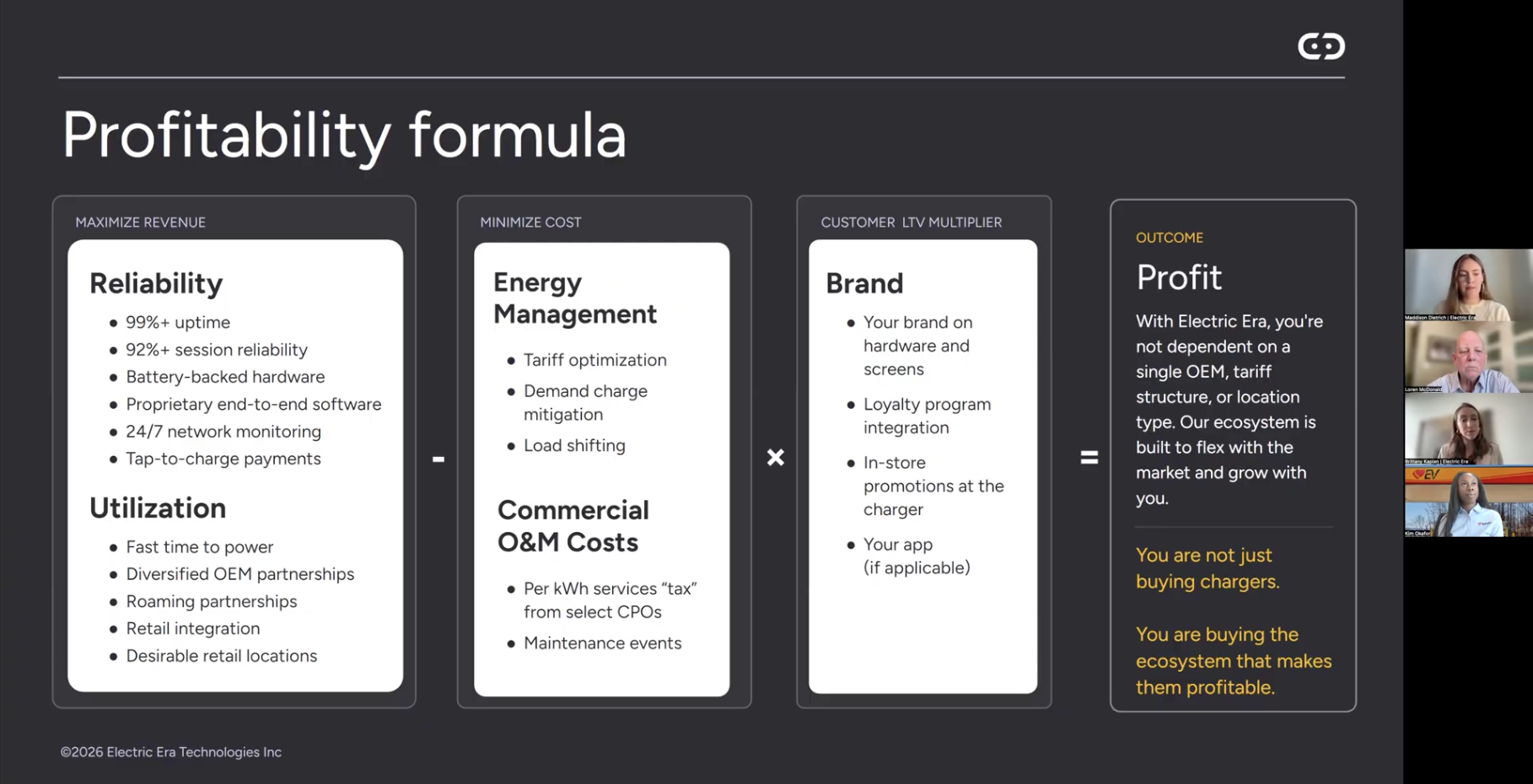
Kim Okafor of Love's Travel Stops, and Loren McDonald of Chargeonomics joined us to discuss what makes an EV fast charging site profitable. The hour-long conversation was framed around the Profitability Formula and covered a wide range of topics.
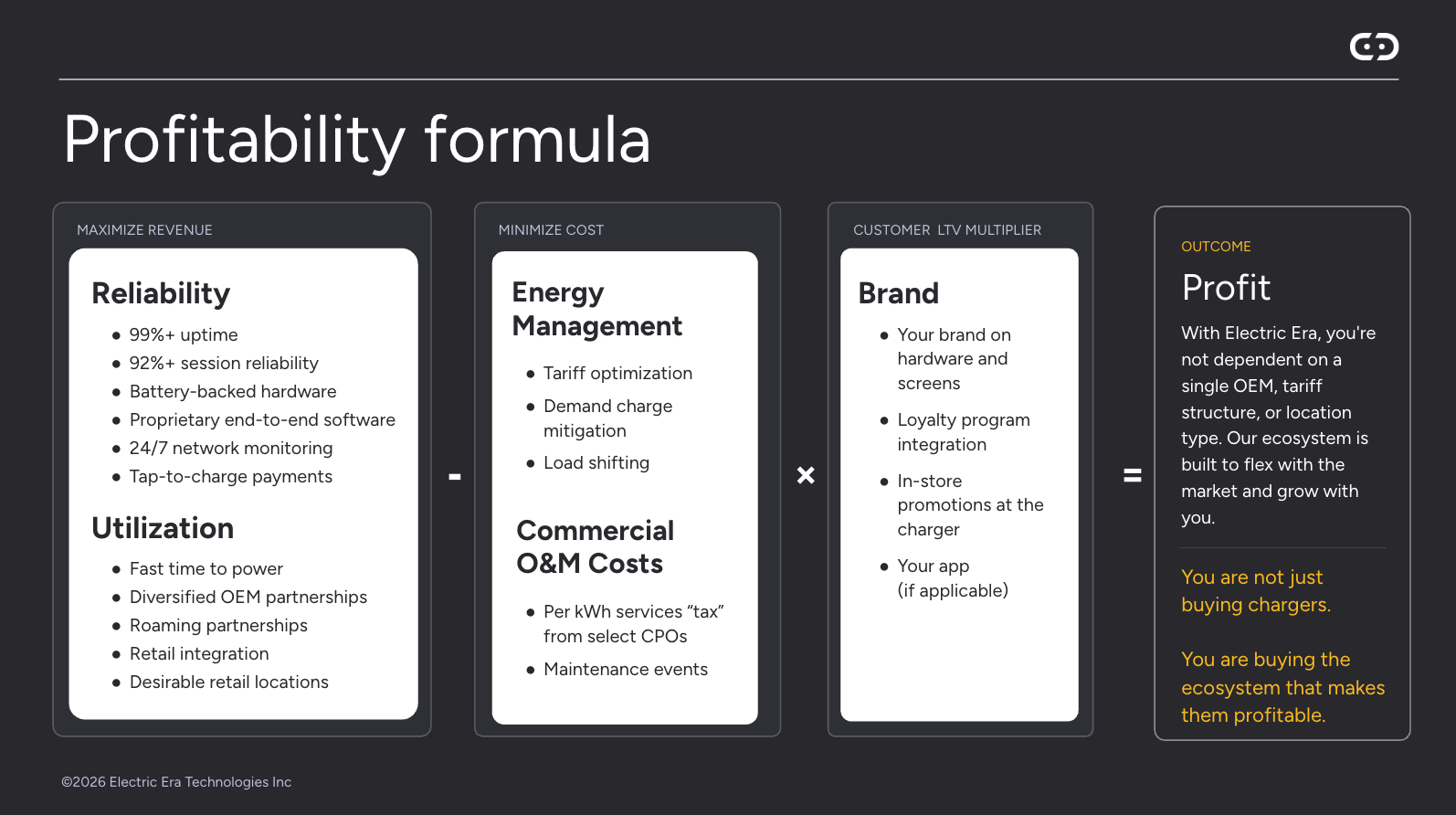
Below are our top takeaways. You can watch the full webinar here.
1. Gas pump reliability is the bar
Brittany Kaplan, Electric Era: “The standard for gas and fuel today is every single time somebody rolls up to the pump, it works every single time. And that’s really the standard that we need to set for EV charging. So 99% uptime, 92% first-shot reliability is the standard that we are setting.”
2. But reliability is table stakes, not a growth strategy
Loren McDonald, Chargenomics: “Reliability is now just an entry point to the industry. If you have great reliability, that doesn’t guarantee high utilization. But if you have poor reliability, it guarantees almost no utilization.”
3. When it comes to the P&L, retail uplift is icing—charging must stand alone
Maddison Dietrich, Electric Era: “Retail uplift is icing on the cake, but you need to have a business unit that will stand on its own… make charging itself be profitable so that we get all the benefits of that retail uplift as well once you monetize the 30-minute dwell time.”
4. Welcome to “Charging 3.0”
Loren McDonald, Chargenomics: “We’re headed into [Charging] 3.0, which is all about being customer-centric. The customer has never really been the focus of the industry in the past. Now if I want high utilization and a chance at profitability, the game is who can acquire and retain the most customers… it’s how you build trust and brand.”
5. EV station signage? High-rise EV prices catch drivers too late
Kim Okafor, Love’s: “Will Love’s put EV prices on the high-rise sign that we put gasoline prices on? We’ve intentionally chosen not to, because if an EV driver is making a road trip, they typically decide where they’re going to stop before they get to the station. So if you have the price on that high-rise, you actually caught them way too late.”
6. Think about the whole experience—EV drivers still have windshields
Kim Okafor, Love’s: “When you go to a gasoline station… you have windshield wiper fluid, you have trash cans by the gas pump. That’s something that you don’t see in EV. We’ve intentionally done that. All of our EV chargers have several trash cans by them and windshield wiper fluid, because EV drivers still have windshields. EV drivers still have trash. So they should be able to feel that same sort of convenience that a gasoline driver has.”
7. Demand charge pain—and the need for mitigation
Kim Okafor, Love’s: “[A station in Colorado] has exorbitant demand charges. One week we had one person show up and I think they spent somewhere in the range of $15… Well, we spent $59 per kilowatt-hour. And no one else came that week.”
8. Battery is blunt; software makes it strategic
Maddison Dietrich, Electric Era: “We’re able to use the battery to meet demand while still keeping costs really low… A battery itself is kind of a blunt instrument. It’s the software that controls it that makes it really strategic.”
9. Rideshare can be ~1/3 of throughput
Loren McDonald, Chargenomics: “I was on a panel with the CEO of EVgo two days ago in Detroit and I mentioned that 25% of your throughput is rideshare drivers — and he said no, we’re actually now up to almost 30%. They’re headed toward one-third of their throughput from one customer segment: rideshare drivers… who charge sometimes two to three times a day, six days a week.”
10. The question every CPO has to answer
Loren McDonald, Chargenomics: “If you’re a CPO, you have to answer the question: why would an EV driver choose our station versus the competitors across the street? And if you don’t have an answer to that, you’re not going to be profitable and you’re not going to succeed.”
Kim Okafor of Love's Travel Stops, and Loren McDonald of Chargeonomics joined us to discuss what makes an EV fast charging site profitable. The hour-long conversation was framed around the Profitability Formula and covered a wide range of topics.
Below are our top takeaways. You can watch the full webinar here.
1. Gas pump reliability is the bar
Brittany Kaplan, Electric Era: “The standard for gas and fuel today is every single time somebody rolls up to the pump, it works every single time. And that’s really the standard that we need to set for EV charging. So 99% uptime, 92% first-shot reliability is the standard that we are setting.”
2. But reliability is table stakes, not a growth strategy
Loren McDonald, Chargenomics: “Reliability is now just an entry point to the industry. If you have great reliability, that doesn’t guarantee high utilization. But if you have poor reliability, it guarantees almost no utilization.”
3. When it comes to the P&L, retail uplift is icing—charging must stand alone
Maddison Dietrich, Electric Era: “Retail uplift is icing on the cake, but you need to have a business unit that will stand on its own… make charging itself be profitable so that we get all the benefits of that retail uplift as well once you monetize the 30-minute dwell time.”
4. Welcome to “Charging 3.0”
Loren McDonald, Chargenomics: “We’re headed into [Charging] 3.0, which is all about being customer-centric. The customer has never really been the focus of the industry in the past. Now if I want high utilization and a chance at profitability, the game is who can acquire and retain the most customers… it’s how you build trust and brand.”
5. EV station signage? High-rise EV prices catch drivers too late
Kim Okafor, Love’s: “Will Love’s put EV prices on the high-rise sign that we put gasoline prices on? We’ve intentionally chosen not to, because if an EV driver is making a road trip, they typically decide where they’re going to stop before they get to the station. So if you have the price on that high-rise, you actually caught them way too late.”
6. Think about the whole experience—EV drivers still have windshields
Kim Okafor, Love’s: “When you go to a gasoline station… you have windshield wiper fluid, you have trash cans by the gas pump. That’s something that you don’t see in EV. We’ve intentionally done that. All of our EV chargers have several trash cans by them and windshield wiper fluid, because EV drivers still have windshields. EV drivers still have trash. So they should be able to feel that same sort of convenience that a gasoline driver has.”
7. Demand charge pain—and the need for mitigation
Kim Okafor, Love’s: “[A station in Colorado] has exorbitant demand charges. One week we had one person show up and I think they spent somewhere in the range of $15… Well, we spent $59 per kilowatt-hour. And no one else came that week.”
8. Battery is blunt; software makes it strategic
Maddison Dietrich, Electric Era: “We’re able to use the battery to meet demand while still keeping costs really low… A battery itself is kind of a blunt instrument. It’s the software that controls it that makes it really strategic.”
9. Rideshare can be ~1/3 of throughput
Loren McDonald, Chargenomics: “I was on a panel with the CEO of EVgo two days ago in Detroit and I mentioned that 25% of your throughput is rideshare drivers — and he said no, we’re actually now up to almost 30%. They’re headed toward one-third of their throughput from one customer segment: rideshare drivers… who charge sometimes two to three times a day, six days a week.”
10. The question every CPO has to answer
Loren McDonald, Chargenomics: “If you’re a CPO, you have to answer the question: why would an EV driver choose our station versus the competitors across the street? And if you don’t have an answer to that, you’re not going to be profitable and you’re not going to succeed.”