Data center flexibility, speed to power, and profitability via autonomy-first software controls


TL;DR
- In my last post, we dove deep into our autonomy-first, software-driven operations platform to show how we achieve industry-leading power availability via real-time fault detection, isolation, and recovery (FDIR) algorithms and intelligent feedback loops for continuous improvement.
- That same operations platform enables similar real-time, autonomous decision-making across other facets that directly impact your bottom line, such as utility tariff optimization (saving hundreds of thousands per year), adherence to flexible interconnection agreements (achieving the fastest path to power in as little as 12 months in places like ERCOT), grid services (participation in bulk electricity markets), and above-grid power augmentation (dispatching power over substation limits to support tenant oversubscription).
- Making rapid decisions at the grid edge is one feat, but another challenge is balancing and prioritizing energy across these domains, ensuring adequate energy is available when needed for critical functions.
- There are many other domains ripe for optimization. This is an agile system, equipped for the ever-changing energy landscape.
Autonomy-driven availability
In my last blog post, linked above, we broke down the ingredients behind our 99.99% uptime guarantee; a critical component being our autonomy-first, software-driven platform for sub-second fault resolution without human intervention. In contrast, legacy solutions use people as the first line of defense.
We covered the ingredients required to make autonomous decisions at the grid edge:
- Continuous shared state; all assets exchange real-time telemetry on a common bus.
- Deterministic energy control at the edge; real-time control loops; <3 ms power control response.
- Deep hardware integrations; access to and monitoring of real-time telemetry and state.
- Deep software-first feedback loops; field data insights and retrospective analysis to strengthen performance.
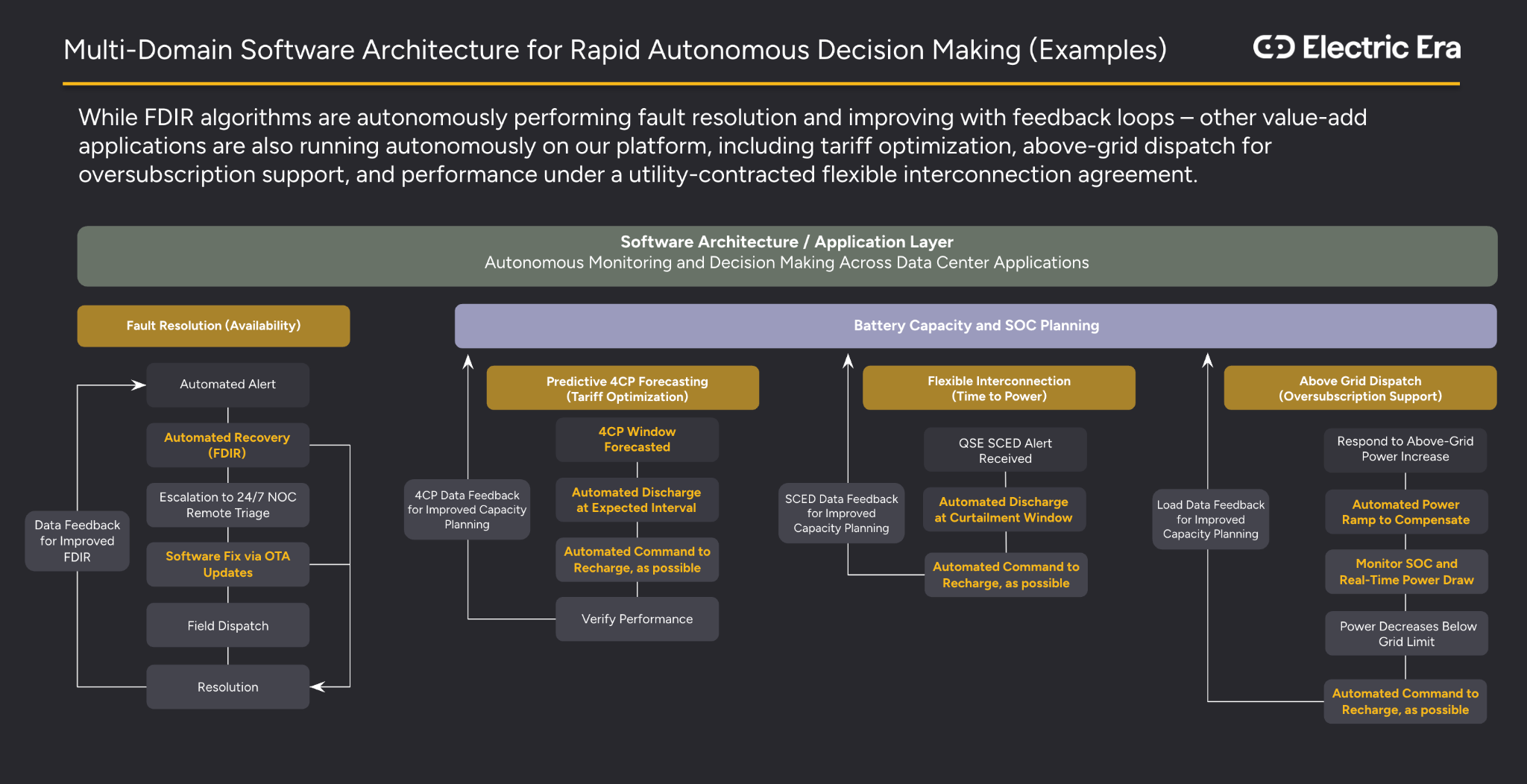
This technical foundation can be leveraged by many other applications for real-time, autonomous decisions at the grid edge, opening up new avenues for profitability and speed to market, see Figure 1.
Let’s look at two of these applications in more detail:
Tariff optimization: Predicting and avoiding 4CP (Four Coincident Peak) charges
Regional Transmission Organizations (RTOs) leverage coincident peak rate schemes (generally four or five events per year) to retroactively recover costs associated with high peak demand intervals. ERCOT, as an example, reviews historical data and identifies the single highest 15-minute system-wide electricity demand interval in each of the four summer months. Transmission and Distribution Utilities (TDUs) then charge their customers via a Transmission Cost Recovery Factor (TCRF) rate tariff. TCRF rates vary across TDUs but a general average is $6.25/kW/month.
How can data centers get ahead of these charges? By predicting the 4CP events in advance (using historical event data, weather, and system demand data) and discharging the BESS during an expected 4CP window. At 10 MW BESS, data centers can avoid $750,000 per year by participating during these four 15-minute intervals ($6.25/kW x 10 MW x 1000 x 12 months).
The trick is to: 1) know in advance when the events will happen, and 2) condition the BESS to the appropriate state of charge (SoC) to take full advantage of the window. Both of these require advanced predictive analytics, automated SoC planning and discharge at the correct window, and software feedback loops to continuously improve forecasting accuracy.
Normally, this would take a small team of people. We achieve this today with our autonomous, software-driven operations platform – no human intervention needed, with more reliable results. Electric Era has proven these capabilities in the field, read here for more. Next, let’s look at operation under a flexible interconnection agreement.
Accelerating time-to-power: Flexible interconnection
As discussed in our post about flexible interconnection, many RTOs and TDUs allow data centers to leverage BESS to become flexible, grid-interactive assets. As a flexible asset, data centers can evaluate non-wires alternatives to avoid lengthy distribution upgrades and remove obstacles to interconnection. In ERCOT, for example, you can register as a Controllable Load Resource (CLR), a classification which allows the utility to see the data center load as flexible and curtailable during specific windows during operation.
BESS is the key – discharging during TDU-mandated curtailment windows so tenant load is not impacted (see Figure 2). In exchange for accelerated interconnection (~12 months end-to-end), your data center operates as a flexible resource for the utility—a great compromise.
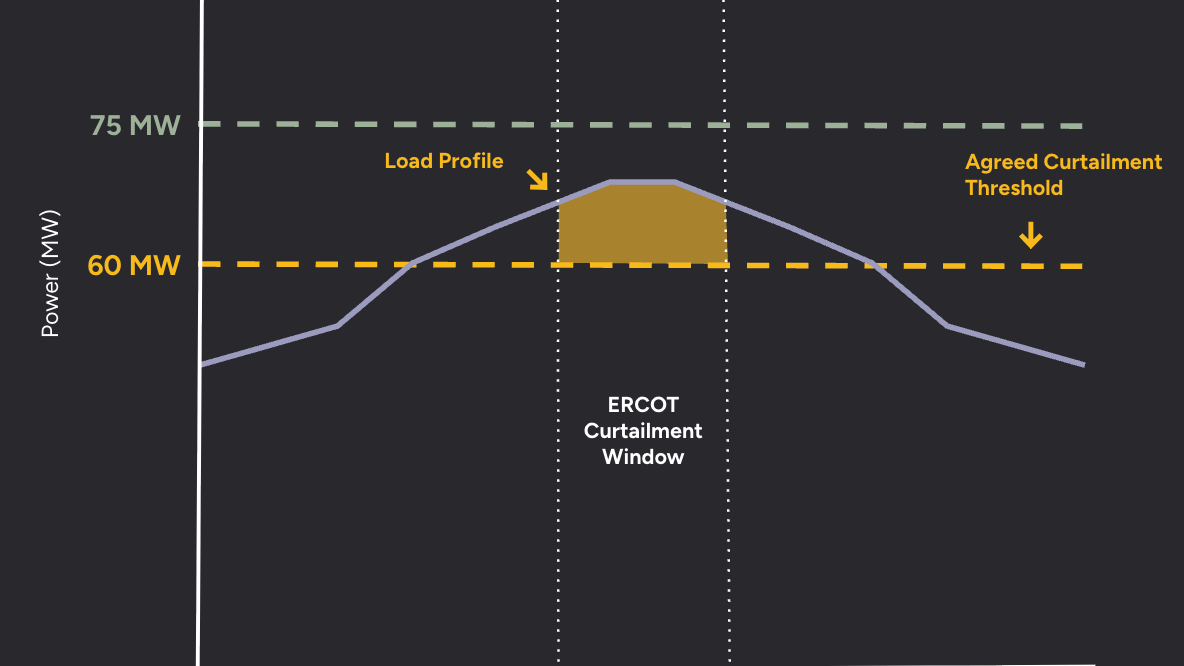
How does this work in practice? With 5-minutes notice, an ERCOT Qualified Scheduling Entity (QSE) will issue a Security-Constrained Economic Dispatch (SCED) and you will be expected to reduce your load to a predetermined curtailment threshold. Tenant load remains unaffected, the battery does all the heavy lifting.
The stakes can be high. If your BESS is offline or doesn’t have the energy capacity on-hand, your tenants could be curtailed or you might see a heavy penalty from your TDU. This issue is completely resolved with: 1) guaranteed availability up to 99.99% (rest assured the asset will be online), 2) predictive SCED forecasting and SoC planning to ensure energy capacity is available, and 3) automated discharge upon notice from the QSE. Then, as with tariff optimization, we take data from SCED events to improve our forecasting and capacity planning for future events. At Electric Era, the end-to-end process is performed by software and autonomous decision making frameworks. Nothing here waits on a person.
Conclusion
With the right system, all of these applications (and more) can be performed simultaneously, in real time at your data center. Autonomy-first, software-driven frameworks are inherently scalable and smart across all domains and applications. Legacy approaches require people to perform these functions and improve performance. Electric Era leverages deterministic energy control, deep hardware integrations and knowledge, and software feedback loops to enable not only industry-leading availability but also improved profitability and accelerated time to power by making smarter, autonomous decisions at your data center.
At your data center, specific applications will depend on your business objectives, site characteristics, rate tariffs, tenant demand, more. It could be saving $750,000+ on your utility bill by forecasting 4CP days in ERCOT, performing as a Controllable Load Resource to take 3-7 years off your interconnection timeline, or something unique to your specific use-case. The only constant across all your projects will be high availability and performance.
Get in touch to learn what our autonomy-first, software-driven operations platform can deliver for your specific requirements, use-cases, and business objectives.
TL;DR
- In my last post, we dove deep into our autonomy-first, software-driven operations platform to show how we achieve industry-leading power availability via real-time fault detection, isolation, and recovery (FDIR) algorithms and intelligent feedback loops for continuous improvement.
- That same operations platform enables similar real-time, autonomous decision-making across other facets that directly impact your bottom line, such as utility tariff optimization (saving hundreds of thousands per year), adherence to flexible interconnection agreements (achieving the fastest path to power in as little as 12 months in places like ERCOT), grid services (participation in bulk electricity markets), and above-grid power augmentation (dispatching power over substation limits to support tenant oversubscription).
- Making rapid decisions at the grid edge is one feat, but another challenge is balancing and prioritizing energy across these domains, ensuring adequate energy is available when needed for critical functions.
- There are many other domains ripe for optimization. This is an agile system, equipped for the ever-changing energy landscape.
Autonomy-driven availability
In my last blog post, linked above, we broke down the ingredients behind our 99.99% uptime guarantee; a critical component being our autonomy-first, software-driven platform for sub-second fault resolution without human intervention. In contrast, legacy solutions use people as the first line of defense.
We covered the ingredients required to make autonomous decisions at the grid edge:
- Continuous shared state; all assets exchange real-time telemetry on a common bus.
- Deterministic energy control at the edge; real-time control loops; <3 ms power control response.
- Deep hardware integrations; access to and monitoring of real-time telemetry and state.
- Deep software-first feedback loops; field data insights and retrospective analysis to strengthen performance.
This technical foundation can be leveraged by many other applications for real-time, autonomous decisions at the grid edge, opening up new avenues for profitability and speed to market, see Figure 1.
Let’s look at two of these applications in more detail:
Tariff optimization: Predicting and avoiding 4CP (Four Coincident Peak) charges
Regional Transmission Organizations (RTOs) leverage coincident peak rate schemes (generally four or five events per year) to retroactively recover costs associated with high peak demand intervals. ERCOT, as an example, reviews historical data and identifies the single highest 15-minute system-wide electricity demand interval in each of the four summer months. Transmission and Distribution Utilities (TDUs) then charge their customers via a Transmission Cost Recovery Factor (TCRF) rate tariff. TCRF rates vary across TDUs but a general average is $6.25/kW/month.
How can data centers get ahead of these charges? By predicting the 4CP events in advance (using historical event data, weather, and system demand data) and discharging the BESS during an expected 4CP window. At 10 MW BESS, data centers can avoid $750,000 per year by participating during these four 15-minute intervals ($6.25/kW x 10 MW x 1000 x 12 months).
The trick is to: 1) know in advance when the events will happen, and 2) condition the BESS to the appropriate state of charge (SoC) to take full advantage of the window. Both of these require advanced predictive analytics, automated SoC planning and discharge at the correct window, and software feedback loops to continuously improve forecasting accuracy.
Normally, this would take a small team of people. We achieve this today with our autonomous, software-driven operations platform – no human intervention needed, with more reliable results. Electric Era has proven these capabilities in the field, read here for more. Next, let’s look at operation under a flexible interconnection agreement.
Accelerating time-to-power: Flexible interconnection
As discussed in our post about flexible interconnection, many RTOs and TDUs allow data centers to leverage BESS to become flexible, grid-interactive assets. As a flexible asset, data centers can evaluate non-wires alternatives to avoid lengthy distribution upgrades and remove obstacles to interconnection. In ERCOT, for example, you can register as a Controllable Load Resource (CLR), a classification which allows the utility to see the data center load as flexible and curtailable during specific windows during operation.
BESS is the key – discharging during TDU-mandated curtailment windows so tenant load is not impacted (see Figure 2). In exchange for accelerated interconnection (~12 months end-to-end), your data center operates as a flexible resource for the utility—a great compromise.
How does this work in practice? With 5-minutes notice, an ERCOT Qualified Scheduling Entity (QSE) will issue a Security-Constrained Economic Dispatch (SCED) and you will be expected to reduce your load to a predetermined curtailment threshold. Tenant load remains unaffected, the battery does all the heavy lifting.
The stakes can be high. If your BESS is offline or doesn’t have the energy capacity on-hand, your tenants could be curtailed or you might see a heavy penalty from your TDU. This issue is completely resolved with: 1) guaranteed availability up to 99.99% (rest assured the asset will be online), 2) predictive SCED forecasting and SoC planning to ensure energy capacity is available, and 3) automated discharge upon notice from the QSE. Then, as with tariff optimization, we take data from SCED events to improve our forecasting and capacity planning for future events. At Electric Era, the end-to-end process is performed by software and autonomous decision making frameworks. Nothing here waits on a person.
Conclusion
With the right system, all of these applications (and more) can be performed simultaneously, in real time at your data center. Autonomy-first, software-driven frameworks are inherently scalable and smart across all domains and applications. Legacy approaches require people to perform these functions and improve performance. Electric Era leverages deterministic energy control, deep hardware integrations and knowledge, and software feedback loops to enable not only industry-leading availability but also improved profitability and accelerated time to power by making smarter, autonomous decisions at your data center.
At your data center, specific applications will depend on your business objectives, site characteristics, rate tariffs, tenant demand, more. It could be saving $750,000+ on your utility bill by forecasting 4CP days in ERCOT, performing as a Controllable Load Resource to take 3-7 years off your interconnection timeline, or something unique to your specific use-case. The only constant across all your projects will be high availability and performance.
Get in touch to learn what our autonomy-first, software-driven operations platform can deliver for your specific requirements, use-cases, and business objectives.