Introducing the Retail EV Charging Index


Which retailers are leading the pack with EV charging
EV charging has quietly become a retail amenity competition. Every c-store, gas station, big box, and grocery chain in the country has had to answer the same question over the last few years: do we get into charging, and if so, how seriously? A wave of market leaders bet early and built their own branded networks. Others, who maybe wanted to dip their toes in the water, let a third party install chargers on their parking lot and called it done. Many have sat it out and just observed.
Today we're launching the Retail EV Charging Index, a regularly updated look at how the top U.S. retailers stack up on EV charging maturity.
What metrics are included
The index is not intended to be an opinion or judgment. Rather, it’s a reflection of where retailers stand on key dimensions. Every retailer is scored on the dimensions and then a weight is applied to create a composite score: Scale at 55%, Experience at 20%, Quality at 15%, and Momentum at 10%.
- Scale is built from live site counts we captured and verified through public trackers, federal Alternative Fuels Data Center records, company press releases. It’s worth noting how difficult it is to capture the “true” live site count—nearly every data source has a different value. This is because stations are constantly being built, some report port counts versus station counts, some stations are operated by the retailer while others are run by a 3rd party CPO or even run by the parking lot real estate owner rather than the retailer.
- Experience captures how integrated the charging experience is with overall retail experience, from simple physical signage and branding to app integration, loyalty program tie-in, and amenity bundling.
- Quality starts from J.D. Power's 2025 U.S. Electric Vehicle Experience (EVX) Public Charging Study, matched and weighted to whichever charging network a retailer uses. We then cross-checked that score against driver ratings pulled from PlugShare listings for each retailer specifically, since two retailers on the same network don't necessarily deliver the same on-the-ground experience.
- Momentum is an AI-assisted score designed to capture recent announcements and propensity to keep building. If all signals point to increasing investment (a new partnership announcement, a growing station volume target, grant wins, etc.), the retailer will score high on Momentum.
Who's at the top, and why
The top of the index is dominated by convenience stores and travel centers—Wawa, BP, Applegreen, Pilot Flying J, Sheetz, and 7-Eleven all sit in the top 10. Then, there’s another cluster of forward-thinking national big box retailers with notably large parking lots—Walmart, Target, and Costco—who have made significant moves to try to establish a position of market leadership.
On one hand, c-store and fuel retail sees EV charging as a natural extension of their existing business (drivers already stop there to fuel up). But on the other hand, forward-looking retailers see this as an opportunity to dominate the next generation and build new habits.
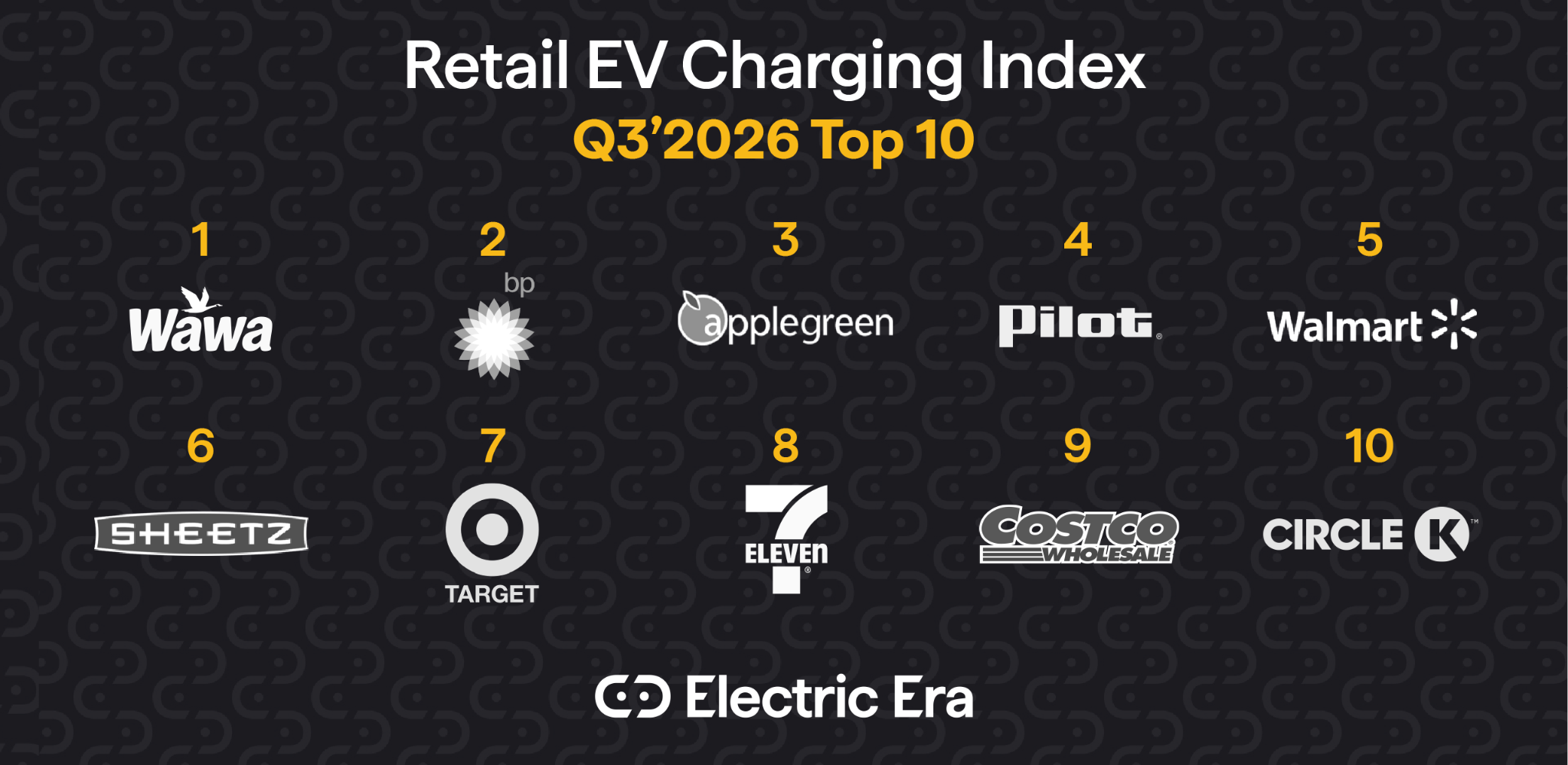
At the top of the list, Wawa takes the #1 spot, and its path there is instructive. Not only does it have one of the largest footprints (275+ stations), they’ve been in the EV charging game since 2017 and have since deployed a mix of ownership models with different hardware providers, demonstrating how their rollout has matured and changed over time. BP and Applegreen round out the top three, each with their own networks (bp pulse and Applegreen Electric, respectively) rather than raw station count. (Note: BP’s station count did not include bp pulse deployments with other retailers.)
Grocery is a story of the next wave of adoption—17 of the top 50 retailers are grocers, and most of them cluster in the bottom half of the list. The exceptions (Meijer, WinCo, Kroger) tend to be the ones that partnered with a national network to kickstart their portfolio.
Who scored low
The total list of retailers with some EV charging activity comprised over 100 companies. Those at the bottom and those who didn't make the list tell a consistent story: small regional grocers and specialty retailers (furniture, sporting goods, etc.) with one or two chargers installed almost as an afterthought, usually hosted entirely by a third-party network with no physical or digital branding connection at the point of charge.
Many of these may be one-off deals orchestrated by the real estate landlord or the result of a building code mandate.
What moves a retailer up the list
The weighting—Scale at 55%, Experience at 20%, Quality at 15%, and Momentum at 10%—shows at a high level what matters. At this stage in the EV charging infrastructure buildout, volume matters. The fastest way to move up is to deploy more stations.
There is more to Scale than simple station count. Owning and operating 100 locations is a very different proposition than leasing out parking spaces to a 3rd party at 100 locations. Ownership shows a level of commitment on the retailer’s part and lends itself to developing a holistic retail experience over time. In the current iteration of the index, owning is a 4x multiplier compared to a pure site host model (hybrid gets 2x). Essentially, a portfolio of 10 fully-owned stations carry the same Scale weight as 40 stations where a retailer is just the parking space landlord. It’s one of the reasons Kwik Trip scores high.
What to expect going forward
This index is designed to tell the evolving story of EV charging deployment, not sit still. We will update the index quarterly, and share an analysis of biggest movers and overall industry trends.
If you're a retailer and think we have your numbers wrong, or you've got news we should know about before the next refresh, we want to hear about it. Send us a note at marketing@electricera.tech.
See the Retail EV Charging Index.
Which retailers are leading the pack with EV charging
EV charging has quietly become a retail amenity competition. Every c-store, gas station, big box, and grocery chain in the country has had to answer the same question over the last few years: do we get into charging, and if so, how seriously? A wave of market leaders bet early and built their own branded networks. Others, who maybe wanted to dip their toes in the water, let a third party install chargers on their parking lot and called it done. Many have sat it out and just observed.
Today we're launching the Retail EV Charging Index, a regularly updated look at how the top U.S. retailers stack up on EV charging maturity.
What metrics are included
The index is not intended to be an opinion or judgment. Rather, it’s a reflection of where retailers stand on key dimensions. Every retailer is scored on the dimensions and then a weight is applied to create a composite score: Scale at 55%, Experience at 20%, Quality at 15%, and Momentum at 10%.
- Scale is built from live site counts we captured and verified through public trackers, federal Alternative Fuels Data Center records, company press releases. It’s worth noting how difficult it is to capture the “true” live site count—nearly every data source has a different value. This is because stations are constantly being built, some report port counts versus station counts, some stations are operated by the retailer while others are run by a 3rd party CPO or even run by the parking lot real estate owner rather than the retailer.
- Experience captures how integrated the charging experience is with overall retail experience, from simple physical signage and branding to app integration, loyalty program tie-in, and amenity bundling.
- Quality starts from J.D. Power's 2025 U.S. Electric Vehicle Experience (EVX) Public Charging Study, matched and weighted to whichever charging network a retailer uses. We then cross-checked that score against driver ratings pulled from PlugShare listings for each retailer specifically, since two retailers on the same network don't necessarily deliver the same on-the-ground experience.
- Momentum is an AI-assisted score designed to capture recent announcements and propensity to keep building. If all signals point to increasing investment (a new partnership announcement, a growing station volume target, grant wins, etc.), the retailer will score high on Momentum.
Who's at the top, and why
The top of the index is dominated by convenience stores and travel centers—Wawa, BP, Applegreen, Pilot Flying J, Sheetz, and 7-Eleven all sit in the top 10. Then, there’s another cluster of forward-thinking national big box retailers with notably large parking lots—Walmart, Target, and Costco—who have made significant moves to try to establish a position of market leadership.
On one hand, c-store and fuel retail sees EV charging as a natural extension of their existing business (drivers already stop there to fuel up). But on the other hand, forward-looking retailers see this as an opportunity to dominate the next generation and build new habits.
At the top of the list, Wawa takes the #1 spot, and its path there is instructive. Not only does it have one of the largest footprints (275+ stations), they’ve been in the EV charging game since 2017 and have since deployed a mix of ownership models with different hardware providers, demonstrating how their rollout has matured and changed over time. BP and Applegreen round out the top three, each with their own networks (bp pulse and Applegreen Electric, respectively) rather than raw station count. (Note: BP’s station count did not include bp pulse deployments with other retailers.)
Grocery is a story of the next wave of adoption—17 of the top 50 retailers are grocers, and most of them cluster in the bottom half of the list. The exceptions (Meijer, WinCo, Kroger) tend to be the ones that partnered with a national network to kickstart their portfolio.
Who scored low
The total list of retailers with some EV charging activity comprised over 100 companies. Those at the bottom and those who didn't make the list tell a consistent story: small regional grocers and specialty retailers (furniture, sporting goods, etc.) with one or two chargers installed almost as an afterthought, usually hosted entirely by a third-party network with no physical or digital branding connection at the point of charge.
Many of these may be one-off deals orchestrated by the real estate landlord or the result of a building code mandate.
What moves a retailer up the list
The weighting—Scale at 55%, Experience at 20%, Quality at 15%, and Momentum at 10%—shows at a high level what matters. At this stage in the EV charging infrastructure buildout, volume matters. The fastest way to move up is to deploy more stations.
There is more to Scale than simple station count. Owning and operating 100 locations is a very different proposition than leasing out parking spaces to a 3rd party at 100 locations. Ownership shows a level of commitment on the retailer’s part and lends itself to developing a holistic retail experience over time. In the current iteration of the index, owning is a 4x multiplier compared to a pure site host model (hybrid gets 2x). Essentially, a portfolio of 10 fully-owned stations carry the same Scale weight as 40 stations where a retailer is just the parking space landlord. It’s one of the reasons Kwik Trip scores high.
What to expect going forward
This index is designed to tell the evolving story of EV charging deployment, not sit still. We will update the index quarterly, and share an analysis of biggest movers and overall industry trends.
If you're a retailer and think we have your numbers wrong, or you've got news we should know about before the next refresh, we want to hear about it. Send us a note at marketing@electricera.tech.
See the Retail EV Charging Index.