Case Study: Ensuring grid compliance at Plaid Pantry



What is power quality management, and why is it important for data centers?
Data centers present a challenge for utilities’ ability to operate successfully and deliver service to customers. In recent years, as data center loads and interconnected power profiles have changed (especially with increasing AI loads), utilities are most concerned about the following:
- Sudden (sub-second) load loss
- Ramp rates and power oscillations from AI training
- Flicker and rapid voltage change
- Voltage stability
- Harmonics and resonance
These challenges overlap in their origin to some extent, and the most common cause is relatively rapid and large fluctuations in power from data center IT loads.
“Relatively rapid” in this case means faster than utilities can respond to changes and successfully regulate generation using existing control systems; “relatively large” means similar in magnitude to individual generation plants and of high enough current that, when multiplied by the transmission and distribution network’s impedance, causes an unacceptable deviation in voltage. For example, a data center running AI training workloads can have GW scale load fluctuations in milliseconds.
How does battery storage solve the problem?
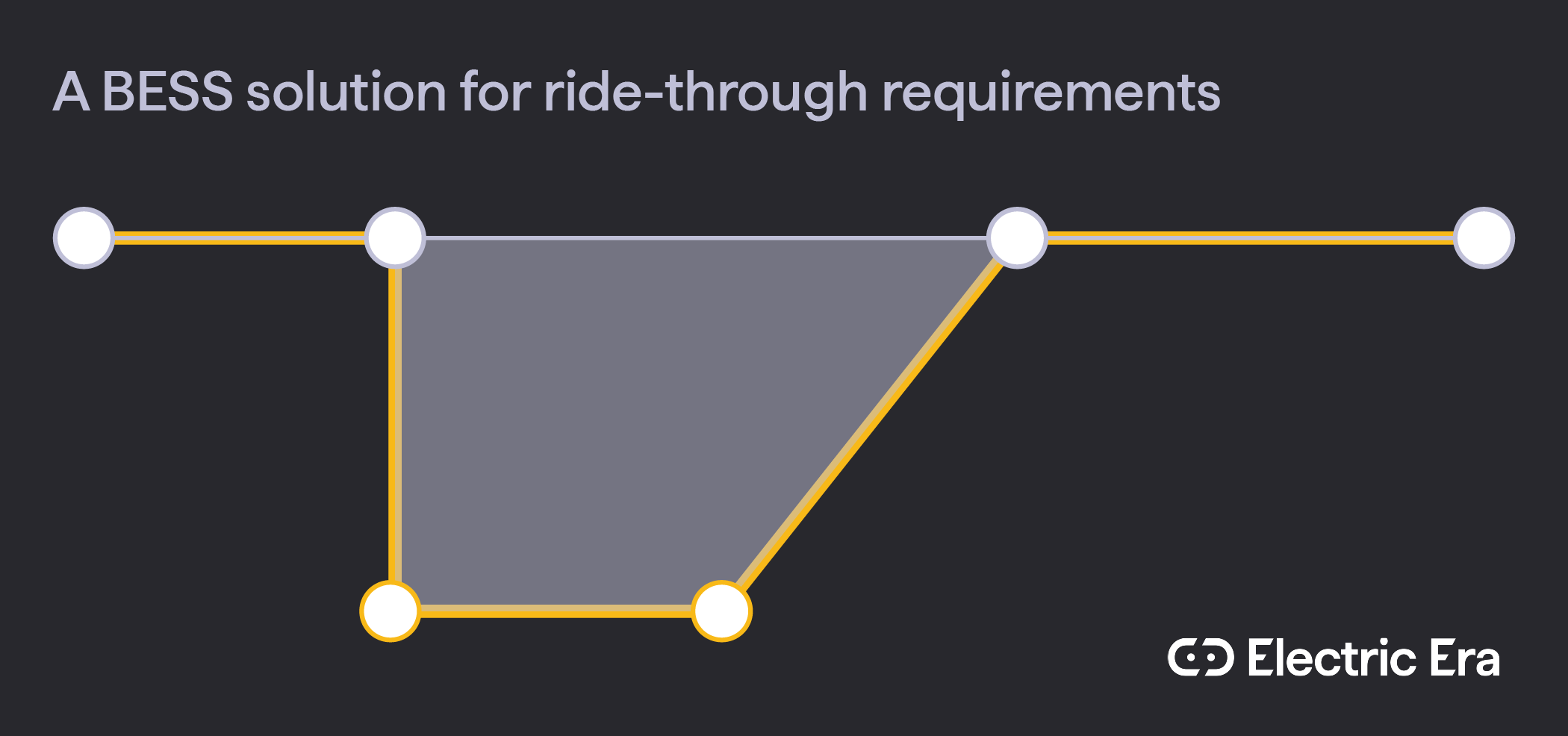
Battery storage (often referred to as BESS, or a Battery Energy Storage System), on the grid or colocated with a data center, is a popular method of addressing the challenges brought by data center loads. BESS excels at “smoothing” the “rough” loads that cause grid disturbances, acting as a capacitor to inject and absorb energy.
Specifically, BESS can:
- Power data centers through small disturbances that already exist on the grid, eliminating the need for IT loads to switch to UPS to maintain operation, which would cause a sudden loss of load to the grid;
- Act in grid-forming mode as a voltage source, aiding in flicker mitigation and voltage stability;
- Inject and absorb real power to counter power oscillations and achieve much lower resulting power ramp rates presented to the utility.
But even when not in grid-forming mode (thus, in grid-following mode), the inverters in BESS can regulate using a fast control loop to maintain voltage stability in the presence of a relatively weak grid.
Example: Electric Era’s BESS implementation at Plaid Pantry
When it comes to grid compliance and power quality, EV fast charging and data center loads serve as useful comparisons. While the scale may be different, their average-to-peak load profiles and the impact of rapid spikiness on their local grid connection are quite similar, which makes BESS a useful solution for both.
Electric Era’s first EV charging installation is a DC fast charger served by a shared 208V, 3-phase service that already serves a Plaid Pantry convenience store and a Starbucks. When first installed, there was 25 kW for the charging station; the headroom has since increased to 45 kW.
This installation is a great example of power stacking, or above-the-grid charging: when a vehicle calls for the charger’s full output, the BESS contributes 125 kW to the grid’s 45, enabling much faster charging than would be possible with this utility service.
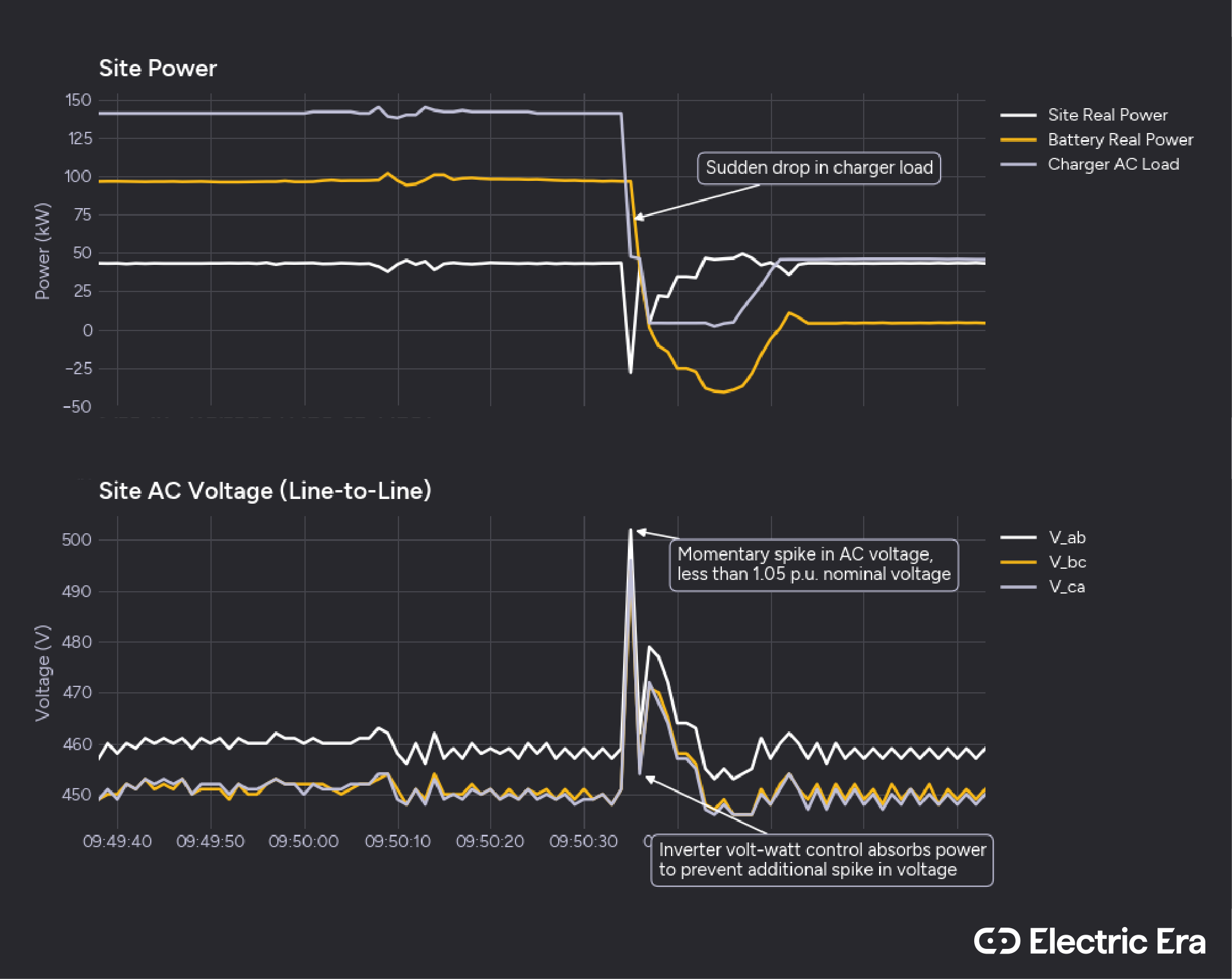
That power stacking story only looks at the steady-state power, but DC fast charging also presents relatively fast power transients to the grid: a charger may ramp from 0 to 170 kW in less than 10 seconds, but more importantly, the load may drop from 170 to 0 kW in a second when the charging session terminates (e.g., some drivers will let their vehicle charge to 100%, tapering off power slowly based on the vehicle’s battery protection controls; but some drivers will opportunistically charge and stop the session mid-way).
For a data center — and for the bulk energy system — a sudden loss of 170 kW isn’t noticeable. But for the end of the local distribution system at this charging station, it can create an unacceptable voltage spike that can damage equipment and cause upstream issues. This is because the grid’s impedance is high (i.e., the grid is “weak”), and the quick decrease in current multiplied by the grid’s impedance leads to a quick increase in voltage.
Volt-watt mode
At Plaid Pantry, the BESS is configured in volt-watt mode: the inverter senses the grid voltage and, in a control loop running faster than the transient at the end of a charging session, automatically absorbs power to smooth the transient load and keep the grid voltage regulated down (volt-watt control works in the other direction, too: the BESS can inject power to keep grid voltage from sagging).
Electric Era implemented volt-watt mode when commissioning the station, to ensure that charging sessions didn’t trip the inverter’s voltage limits (an indication that the local grid voltage may be outside acceptable bounds), and the station has been running in this way for more than 3 years.
Scalable solution
Because the loads at this installation are relatively large for the grid, it can be seen as a case study “in miniature” for how BESS can solve power quality challenges for data centers. Of course, with the feature set made possible by BESS controls, various other challenges (some of which are peculiar to data centers) can easily be solved as well.
What is power quality management, and why is it important for data centers?
Data centers present a challenge for utilities’ ability to operate successfully and deliver service to customers. In recent years, as data center loads and interconnected power profiles have changed (especially with increasing AI loads), utilities are most concerned about the following:
- Sudden (sub-second) load loss
- Ramp rates and power oscillations from AI training
- Flicker and rapid voltage change
- Voltage stability
- Harmonics and resonance
These challenges overlap in their origin to some extent, and the most common cause is relatively rapid and large fluctuations in power from data center IT loads.
“Relatively rapid” in this case means faster than utilities can respond to changes and successfully regulate generation using existing control systems; “relatively large” means similar in magnitude to individual generation plants and of high enough current that, when multiplied by the transmission and distribution network’s impedance, causes an unacceptable deviation in voltage. For example, a data center running AI training workloads can have GW scale load fluctuations in milliseconds.
How does battery storage solve the problem?
Battery storage (often referred to as BESS, or a Battery Energy Storage System), on the grid or colocated with a data center, is a popular method of addressing the challenges brought by data center loads. BESS excels at “smoothing” the “rough” loads that cause grid disturbances, acting as a capacitor to inject and absorb energy.
Specifically, BESS can:
- Power data centers through small disturbances that already exist on the grid, eliminating the need for IT loads to switch to UPS to maintain operation, which would cause a sudden loss of load to the grid;
- Act in grid-forming mode as a voltage source, aiding in flicker mitigation and voltage stability;
- Inject and absorb real power to counter power oscillations and achieve much lower resulting power ramp rates presented to the utility.
But even when not in grid-forming mode (thus, in grid-following mode), the inverters in BESS can regulate using a fast control loop to maintain voltage stability in the presence of a relatively weak grid.
Example: Electric Era’s BESS implementation at Plaid Pantry
When it comes to grid compliance and power quality, EV fast charging and data center loads serve as useful comparisons. While the scale may be different, their average-to-peak load profiles and the impact of rapid spikiness on their local grid connection are quite similar, which makes BESS a useful solution for both.
Electric Era’s first EV charging installation is a DC fast charger served by a shared 208V, 3-phase service that already serves a Plaid Pantry convenience store and a Starbucks. When first installed, there was 25 kW for the charging station; the headroom has since increased to 45 kW.
This installation is a great example of power stacking, or above-the-grid charging: when a vehicle calls for the charger’s full output, the BESS contributes 125 kW to the grid’s 45, enabling much faster charging than would be possible with this utility service.
That power stacking story only looks at the steady-state power, but DC fast charging also presents relatively fast power transients to the grid: a charger may ramp from 0 to 170 kW in less than 10 seconds, but more importantly, the load may drop from 170 to 0 kW in a second when the charging session terminates (e.g., some drivers will let their vehicle charge to 100%, tapering off power slowly based on the vehicle’s battery protection controls; but some drivers will opportunistically charge and stop the session mid-way).
For a data center — and for the bulk energy system — a sudden loss of 170 kW isn’t noticeable. But for the end of the local distribution system at this charging station, it can create an unacceptable voltage spike that can damage equipment and cause upstream issues. This is because the grid’s impedance is high (i.e., the grid is “weak”), and the quick decrease in current multiplied by the grid’s impedance leads to a quick increase in voltage.
Volt-watt mode
At Plaid Pantry, the BESS is configured in volt-watt mode: the inverter senses the grid voltage and, in a control loop running faster than the transient at the end of a charging session, automatically absorbs power to smooth the transient load and keep the grid voltage regulated down (volt-watt control works in the other direction, too: the BESS can inject power to keep grid voltage from sagging).
Electric Era implemented volt-watt mode when commissioning the station, to ensure that charging sessions didn’t trip the inverter’s voltage limits (an indication that the local grid voltage may be outside acceptable bounds), and the station has been running in this way for more than 3 years.
Scalable solution
Because the loads at this installation are relatively large for the grid, it can be seen as a case study “in miniature” for how BESS can solve power quality challenges for data centers. Of course, with the feature set made possible by BESS controls, various other challenges (some of which are peculiar to data centers) can easily be solved as well.