PJM’s ride-through and BYOC proposals and the cross cutting solution: BESS-enabled flexibility


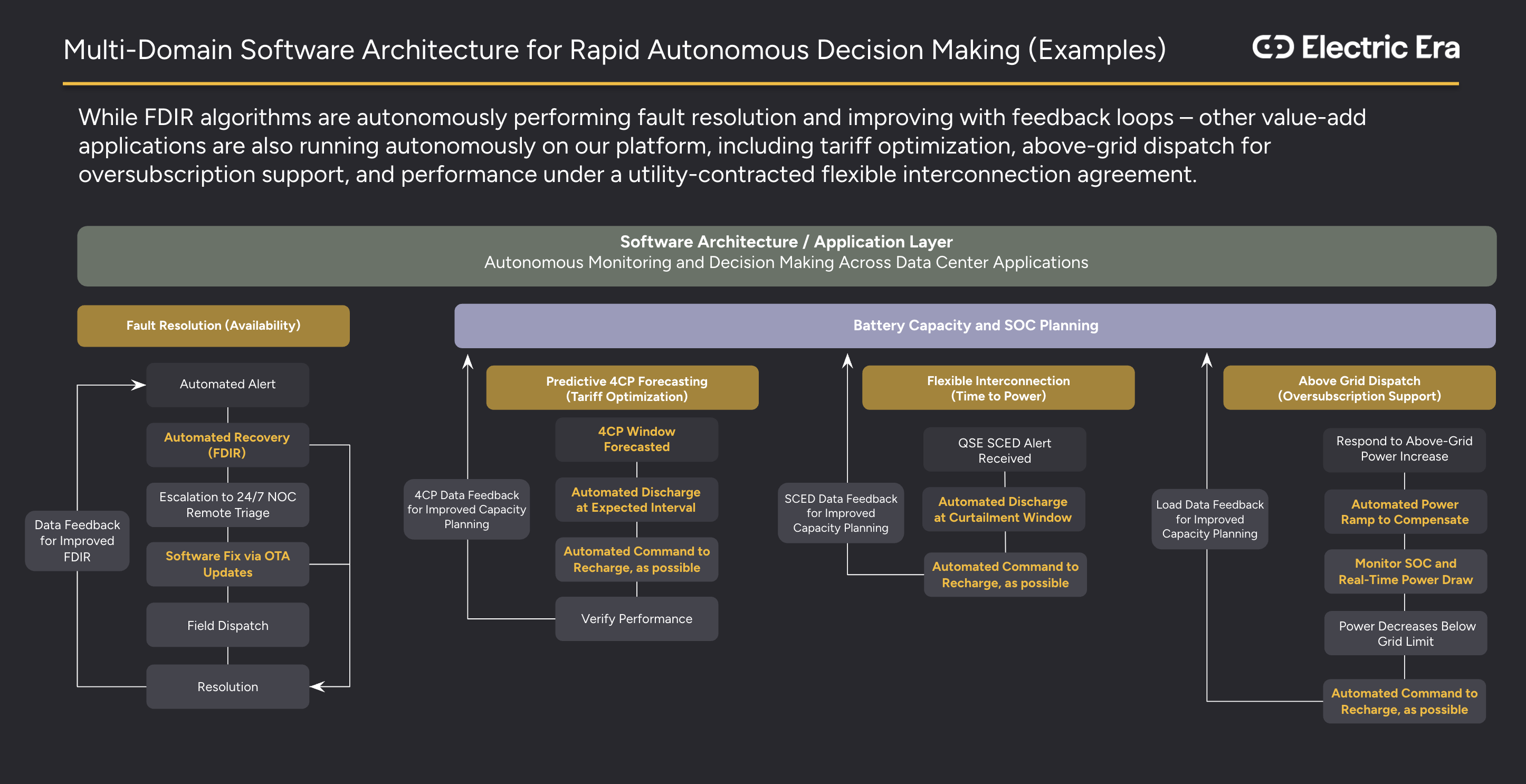
In my last several posts, I’ve discussed how CoPower leverages deep hardware characterization and an autonomy-first operations platform to deliver data center flexibility, accelerated time to power, and better economic performance – all at industry-leading power availability. This blog is about new operating requirements and our approach to using the same platform as a grid compliance tool.
TL;DR
- One of the major responsibilities of Independent System Operators (ISOs) and Transmission and Distribution Utilities (TDUs) is grid reliability, ensuring that power stays on for the millions of people who count on it every day.
- Grid disturbances (from voltage or frequency swings) cause data centers to go on alert and, in the past, operators have erred on the conservative side – switching over to Uninterruptible Power Supplies (UPS) and going off-grid for the duration of the disturbance.
- New “ride-through” rules are being proposed to require data centers to stay connected and keep drawing grid power through grid disturbances, instead of switching to UPS and backup generators. PJM's October 6 proposal would require all data centers at 50 MW peak demand or more to ride-through grid disturbances.
- In parallel, PJM proposed a Bring-Your-Own-New-Capacity (BYONC) rule requiring data center operators to install new generation, storage, or other eligible resources equal to their requested utility load. The Federal Energy Regulatory Commission (FERC) rejected this proposal.
- Flexible assets, like BESS, can be used to solve both of these challenges as long as the solution performs consistently over 99% power availability and is designed for rapid, deterministic decision-making.
1. Ride-through, grid reliability, and data centers
Grid reliability is something the majority of people take for granted. In practice, it takes careful planning and a set of ever-changing rules to make work. One of the many rules ISOs and TDUs establish is called “ride-through,” where a large load stays online, drawing power through a grid disturbance. As an example, faults on transmission lines happen all the time; voltage sags for a fraction of a second, then recovers. Ride-through rules require that large loads maintain operation through that window instead of disconnecting completely.
Since the grid balances supply and demand second by second, a large load (or series of large loads) that disconnects abruptly may cause voltage and frequency swings and create a ripple effect impacting the reliability of the entire network.
If a grid disturbance happens, a data center (if not required to ride-through) may choose to go off-grid, engaging their UPS systems while back-up diesel gen sets ramp up to power the load. They do this to safeguard equipment and, importantly, keep compute power steady to ensure tenant availability service level agreements are maintained; this makes perfect sense as an operator.
However, given the volume of new data centers coming online and their relative importance and impact when planning for reliability, utilities are scrutinizing these new loads and how they behave, as seen in several events over the past few years. On July 10, 2024, 1.5 GW of data center load disconnected abruptly during an event, another 1.8 GW later that year, and 3.8 GW recently on July 22, 2026. Although these events did not result in blackouts, they raised serious reliability concerns and have precipitated new ride-through proposals that will impact how data centers are planned and operated. In PJM, these proposals are gaining momentum and are making their way through regulatory bodies, such as FERC.
2. PJM’s ride-through proposal
FERC and the North American Electric Reliability Corporation (NERC) have been paying attention to these events as they grow in frequency and magnitude. In June 2026, FERC requested that PJM justify the status quo or propose ride-through rules to ensure grid reliability remains strong amidst data center load growth. In parallel, in July 2026, FERC ordered NERC to write standard, nationwide rules for data centers; these (including ride-through requirements) are expected in 2027.
As a result, PJM proposed a set of ride-through rules to govern data center behavior during grid disturbances. Specifically, the following rules are being proposed for data centers with peak demand of 50 MW or greater (source: PJM Large Computational Load (LCL) Ride-Through Requirements, Oct. 6, 2026):
- Data centers must keep drawing grid power through voltage sags, consumption may drop with voltage, but must return above 90% of pre-disturbance level within 2 seconds of voltage recovery.
- No transfer to backup power based on counting sags. If a scheme is unavoidable, the site must stay connected through at least 6 sags in 90 seconds.
- Overcurrent during a sag capped at 150% of normal maximum, for no more than 0.5 seconds.
- Frequency must be continuous from 58.8 to 61.2 Hz, and 299 seconds between 57.0 and 58.8 Hz or 61.2 and 61.8 Hz, staying within 10% of pre-disturbance power.
If enacted, these rules would apply to all data center loads >50 MW: new projects entering the queue, projects currently in study or under agreement, and currently operating data centers. All said, if you currently operate or are planning to operate a data center in PJM that meets the size requirements above, it's time to start thinking about the solution space.
3. PJM’s Bring-Your-Own-Capacity (BYOC) proposal
In June 2026, FERC also raised concerns related to capacity markets (i.e. large loads are interconnecting faster than new generation can be built to serve them). The core concern is that TDUs are not planning for adequate supply, citing that this will raise reliability risk and ratepayer costs.
PJM’s response was to propose that large loads install new generation, storage, or other eligible resources to meet the requested load.
FERC rejected this proposal, among other such as an Interim Resource Adequacy Service (IRAS) proposal which would have allowed large load operators to avoid BYOC by making those large loads subject to curtailment during emergencies.
Again, the core concern is the lack of energy capacity needed to meet dramatic load growth and address the impact that this load growth has on system reliability; this is the exact problem that BESS-driven data center flexibility solves. Despite the proposal rejection, it is highly likely that utilities will require customer-provisioned power generation and storage to accommodate the capacity shortfall.
4. An encompassing solution: Autonomy-first, software-driven BESS
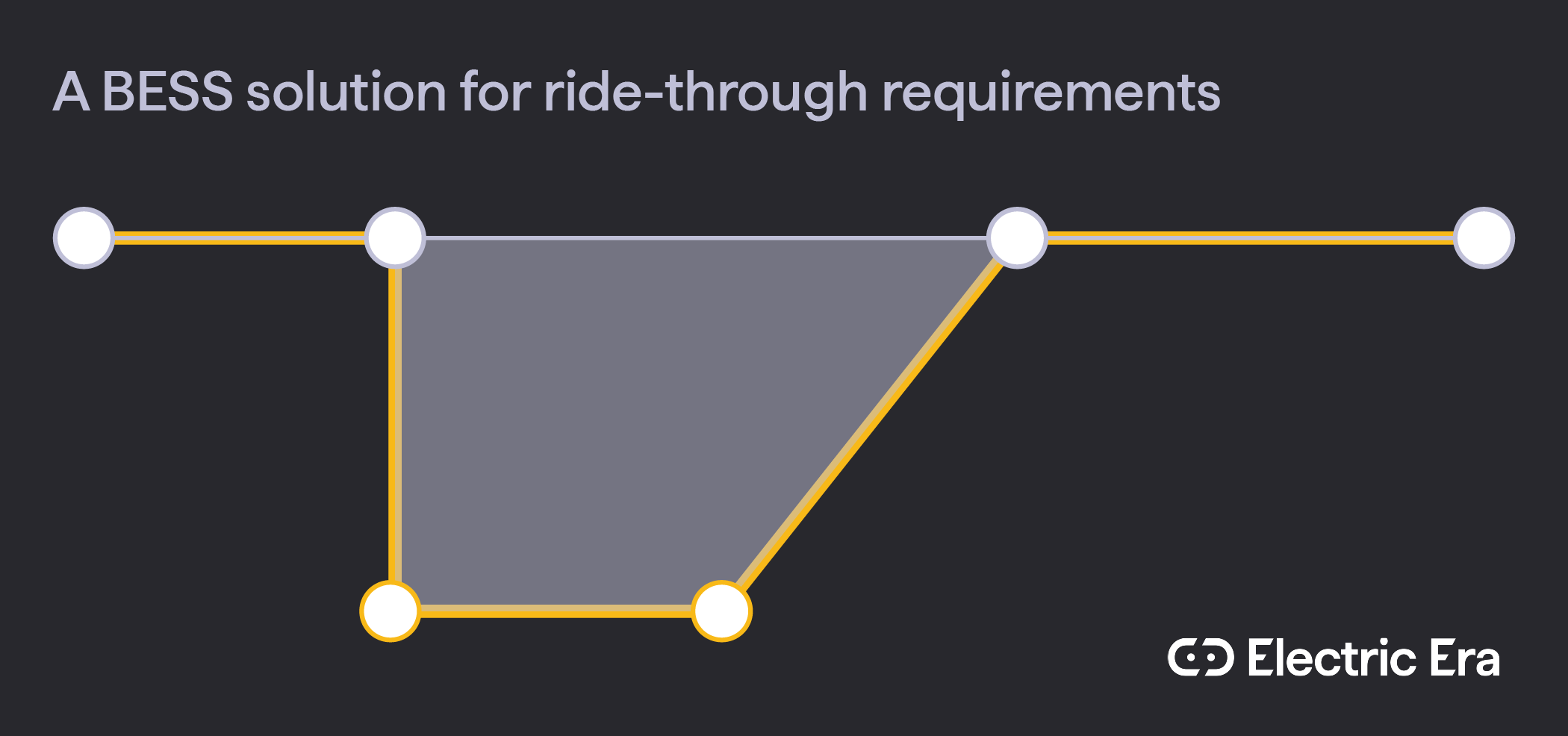
Solution for ride-through requirements
First, advanced inverters and custom controls can be designed to meet utility-specific grid compliance requirements, such as ride-through. In the event of a grid disturbance, when properly configured, BESS can provide immediate bridging power, voltage control, and frequency regulation to satisfy strict, utility-specific ride-through parameters.
As you can imagine, this requires solutions with asset availability consistently above 99% (CoPower guarantees up to 99.99% power availability) to ensure performance, compliance and reporting day-in and day-out. Electric Era routinely performs ride-through and other reliability functions at many of our projects, adhering to utility-mandated parameters.
Solution for capacity constraints and BYOC
PJM’s capacity concerns are found nearly everywhere on the grid – energy demand is outpacing supply. As a flexible asset and non-wires alternative, BESS can help utilities and data center operators alleviate these capacity bottlenecks.
During interconnection, Electric Era helps data center operators achieve this by performing network modeling and BESS sizing exercises – many times working directly with the utility as a subject matter expert – to evaluate non-wire alternatives for interconnection.
We analyze both firm and non-firm load thresholds to explore deferment of network upgrades to get data centers online faster while actively managing supply/capacity gaps. Once in operation, a BESS solution will bridge the gap – meeting curtailment obligations while keeping IT Load consistent. We wrote extensively about this in a previous blog post focused on achieving this in ERCOT.
What does this require? It requires BESS systems architected for operational performance; software-driven platforms with rapid decision-making capability and industry leading power availability (up to 99.99% with CoPower). Whether it’s executing custom ride-through compliance or responding to your utility’s flex connect call, your BESS assets need to, first and foremost, be online/available for use and respond quickly and accurately.
If you’re evaluating flexible interconnection or trying to achieve grid compliance, get in touch with our team for a custom evaluation.
In my last several posts, I’ve discussed how CoPower leverages deep hardware characterization and an autonomy-first operations platform to deliver data center flexibility, accelerated time to power, and better economic performance – all at industry-leading power availability. This blog is about new operating requirements and our approach to using the same platform as a grid compliance tool.
TL;DR
- One of the major responsibilities of Independent System Operators (ISOs) and Transmission and Distribution Utilities (TDUs) is grid reliability, ensuring that power stays on for the millions of people who count on it every day.
- Grid disturbances (from voltage or frequency swings) cause data centers to go on alert and, in the past, operators have erred on the conservative side – switching over to Uninterruptible Power Supplies (UPS) and going off-grid for the duration of the disturbance.
- New “ride-through” rules are being proposed to require data centers to stay connected and keep drawing grid power through grid disturbances, instead of switching to UPS and backup generators. PJM's October 6 proposal would require all data centers at 50 MW peak demand or more to ride-through grid disturbances.
- In parallel, PJM proposed a Bring-Your-Own-New-Capacity (BYONC) rule requiring data center operators to install new generation, storage, or other eligible resources equal to their requested utility load. The Federal Energy Regulatory Commission (FERC) rejected this proposal.
- Flexible assets, like BESS, can be used to solve both of these challenges as long as the solution performs consistently over 99% power availability and is designed for rapid, deterministic decision-making.
1. Ride-through, grid reliability, and data centers
Grid reliability is something the majority of people take for granted. In practice, it takes careful planning and a set of ever-changing rules to make work. One of the many rules ISOs and TDUs establish is called “ride-through,” where a large load stays online, drawing power through a grid disturbance. As an example, faults on transmission lines happen all the time; voltage sags for a fraction of a second, then recovers. Ride-through rules require that large loads maintain operation through that window instead of disconnecting completely.
Since the grid balances supply and demand second by second, a large load (or series of large loads) that disconnects abruptly may cause voltage and frequency swings and create a ripple effect impacting the reliability of the entire network.
If a grid disturbance happens, a data center (if not required to ride-through) may choose to go off-grid, engaging their UPS systems while back-up diesel gen sets ramp up to power the load. They do this to safeguard equipment and, importantly, keep compute power steady to ensure tenant availability service level agreements are maintained; this makes perfect sense as an operator.
However, given the volume of new data centers coming online and their relative importance and impact when planning for reliability, utilities are scrutinizing these new loads and how they behave, as seen in several events over the past few years. On July 10, 2024, 1.5 GW of data center load disconnected abruptly during an event, another 1.8 GW later that year, and 3.8 GW recently on July 22, 2026. Although these events did not result in blackouts, they raised serious reliability concerns and have precipitated new ride-through proposals that will impact how data centers are planned and operated. In PJM, these proposals are gaining momentum and are making their way through regulatory bodies, such as FERC.
2. PJM’s ride-through proposal
FERC and the North American Electric Reliability Corporation (NERC) have been paying attention to these events as they grow in frequency and magnitude. In June 2026, FERC requested that PJM justify the status quo or propose ride-through rules to ensure grid reliability remains strong amidst data center load growth. In parallel, in July 2026, FERC ordered NERC to write standard, nationwide rules for data centers; these (including ride-through requirements) are expected in 2027.
As a result, PJM proposed a set of ride-through rules to govern data center behavior during grid disturbances. Specifically, the following rules are being proposed for data centers with peak demand of 50 MW or greater (source: PJM Large Computational Load (LCL) Ride-Through Requirements, Oct. 6, 2026):
- Data centers must keep drawing grid power through voltage sags, consumption may drop with voltage, but must return above 90% of pre-disturbance level within 2 seconds of voltage recovery.
- No transfer to backup power based on counting sags. If a scheme is unavoidable, the site must stay connected through at least 6 sags in 90 seconds.
- Overcurrent during a sag capped at 150% of normal maximum, for no more than 0.5 seconds.
- Frequency must be continuous from 58.8 to 61.2 Hz, and 299 seconds between 57.0 and 58.8 Hz or 61.2 and 61.8 Hz, staying within 10% of pre-disturbance power.
If enacted, these rules would apply to all data center loads >50 MW: new projects entering the queue, projects currently in study or under agreement, and currently operating data centers. All said, if you currently operate or are planning to operate a data center in PJM that meets the size requirements above, it's time to start thinking about the solution space.
3. PJM’s Bring-Your-Own-Capacity (BYOC) proposal
In June 2026, FERC also raised concerns related to capacity markets (i.e. large loads are interconnecting faster than new generation can be built to serve them). The core concern is that TDUs are not planning for adequate supply, citing that this will raise reliability risk and ratepayer costs.
PJM’s response was to propose that large loads install new generation, storage, or other eligible resources to meet the requested load.
FERC rejected this proposal, among other such as an Interim Resource Adequacy Service (IRAS) proposal which would have allowed large load operators to avoid BYOC by making those large loads subject to curtailment during emergencies.
Again, the core concern is the lack of energy capacity needed to meet dramatic load growth and address the impact that this load growth has on system reliability; this is the exact problem that BESS-driven data center flexibility solves. Despite the proposal rejection, it is highly likely that utilities will require customer-provisioned power generation and storage to accommodate the capacity shortfall.
4. An encompassing solution: Autonomy-first, software-driven BESS
Solution for ride-through requirements
First, advanced inverters and custom controls can be designed to meet utility-specific grid compliance requirements, such as ride-through. In the event of a grid disturbance, when properly configured, BESS can provide immediate bridging power, voltage control, and frequency regulation to satisfy strict, utility-specific ride-through parameters.
As you can imagine, this requires solutions with asset availability consistently above 99% (CoPower guarantees up to 99.99% power availability) to ensure performance, compliance and reporting day-in and day-out. Electric Era routinely performs ride-through and other reliability functions at many of our projects, adhering to utility-mandated parameters.
Solution for capacity constraints and BYOC
PJM’s capacity concerns are found nearly everywhere on the grid – energy demand is outpacing supply. As a flexible asset and non-wires alternative, BESS can help utilities and data center operators alleviate these capacity bottlenecks.
During interconnection, Electric Era helps data center operators achieve this by performing network modeling and BESS sizing exercises – many times working directly with the utility as a subject matter expert – to evaluate non-wire alternatives for interconnection.
We analyze both firm and non-firm load thresholds to explore deferment of network upgrades to get data centers online faster while actively managing supply/capacity gaps. Once in operation, a BESS solution will bridge the gap – meeting curtailment obligations while keeping IT Load consistent. We wrote extensively about this in a previous blog post focused on achieving this in ERCOT.
What does this require? It requires BESS systems architected for operational performance; software-driven platforms with rapid decision-making capability and industry leading power availability (up to 99.99% with CoPower). Whether it’s executing custom ride-through compliance or responding to your utility’s flex connect call, your BESS assets need to, first and foremost, be online/available for use and respond quickly and accurately.
If you’re evaluating flexible interconnection or trying to achieve grid compliance, get in touch with our team for a custom evaluation.