A solution to high demand charges: battery-backed EV charging analysis



For those weighing EV fast charging ownership, the utility bill is the biggest unknown. Energy costs are fairly predictable. Demand charges aren't, and they can quickly turn a profitable station into an unprofitable one.
This uncertainty makes it difficult to answer critical questions for building and operating a site:
What can you charge drivers?
How long will payback take?
Is my site worth building?
This post explains how demand charges work, why waiting for more traffic to dilute them is a risky plan, and how battery-backed charging changes the math.
What are utility demand charges?
Demand charges are fees utilities bill commercial customers based on peak power (kW) to fund grid infrastructure projects. The utility typically calculates the charge based on the highest 15-minute average draw in the billing month.
Monthly demand charge = $/kW x highest 15-minute kW grid draw
That makes Level 3 fast charging especially exposed. A few vehicles charging upwards of 200 to 400 kW at once can push a site to hundreds of kW for a few minutes. That single window sets the demand charge for the whole month, even if the site is quiet the rest of the time. Many tariffs also price demand by time of day. At one of our customer’s Colorado sites, peak-hour demand costs upwards of $28/kW, compared with about $7/kW the rest of the time. One high-powered session at the wrong moment can set a charge that outpaces everything the site earns that month.
Can't more charging sessions just dilute demand charges?
A common argument we hear is: Once a site sets its monthly peak, the demand charge is fixed. Add more sessions and the same charge spreads over more kWh, so total cost per kWh falls. This is sometimes called demand charge dilution.
As a strategy, this has problems. First, it assumes you're already paying for a full peak. The charge stays flat as sessions grow only because a few cars arriving together have already pushed the site close to its maximum. You're paying the top rate and hoping volume catches up. Two, it puts ramp-up risk on the site. New stations spend their first months seeing lower utilization, so relying on sessions to spread out those costs is risky.
How does battery storage help EV charging avoid peak demand charges?
A grid-only station pulls every kW a vehicle asks for straight from the utility. Whatever drivers do in the busiest 15 minutes of the month sets the bill.
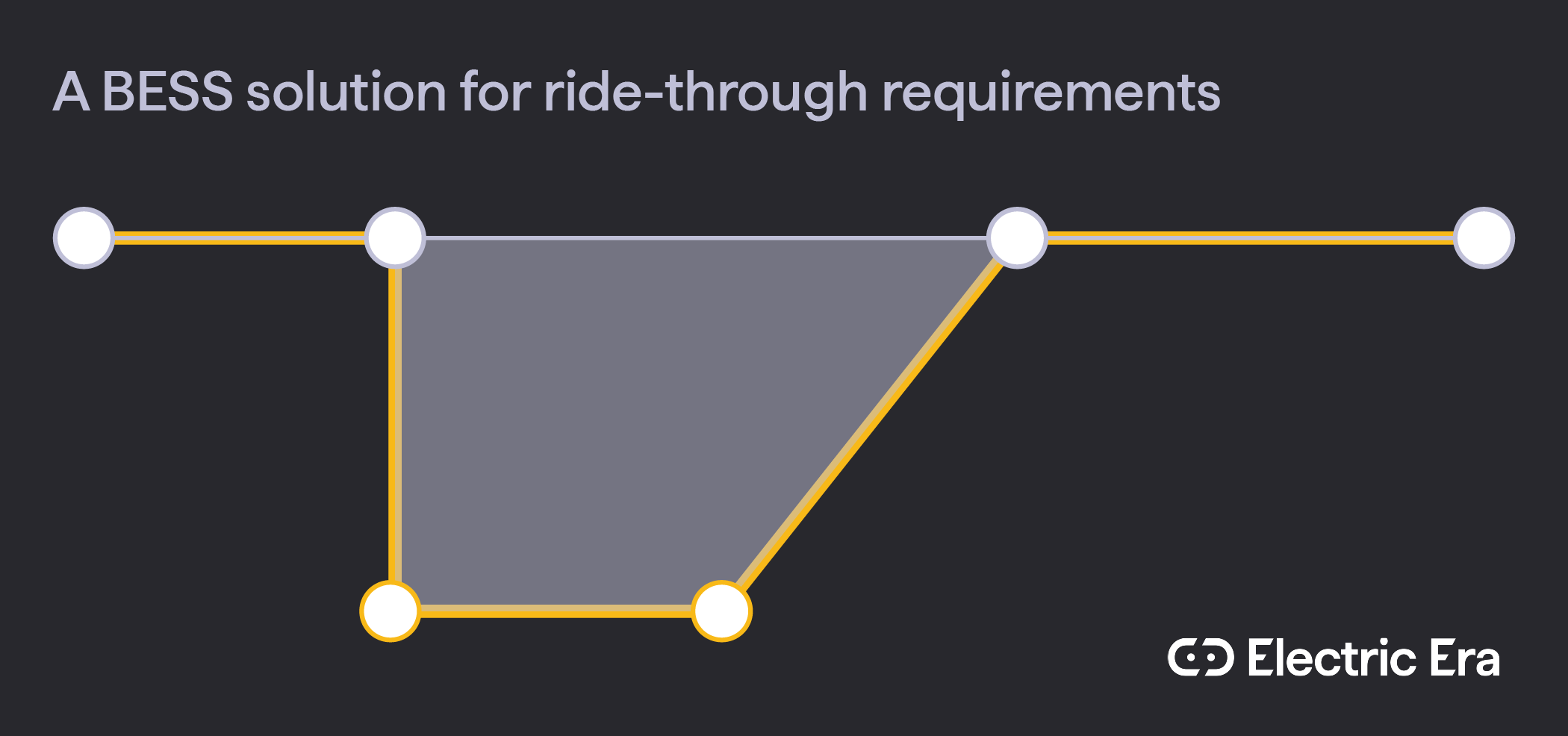
A battery-backed station with energy management software to orchestrate power sources puts a battery energy storage system (BESS) between the chargers and the grid. Software sets a grid limit, a cap on how much power the site may draw from the utility at any moment.
When drivers need more than that cap, the battery covers the difference. The utility only ever sees the capped draw, so billed demand stays tied to a number the operator chooses rather than to when drivers happen to arrive. This is called peak shaving.
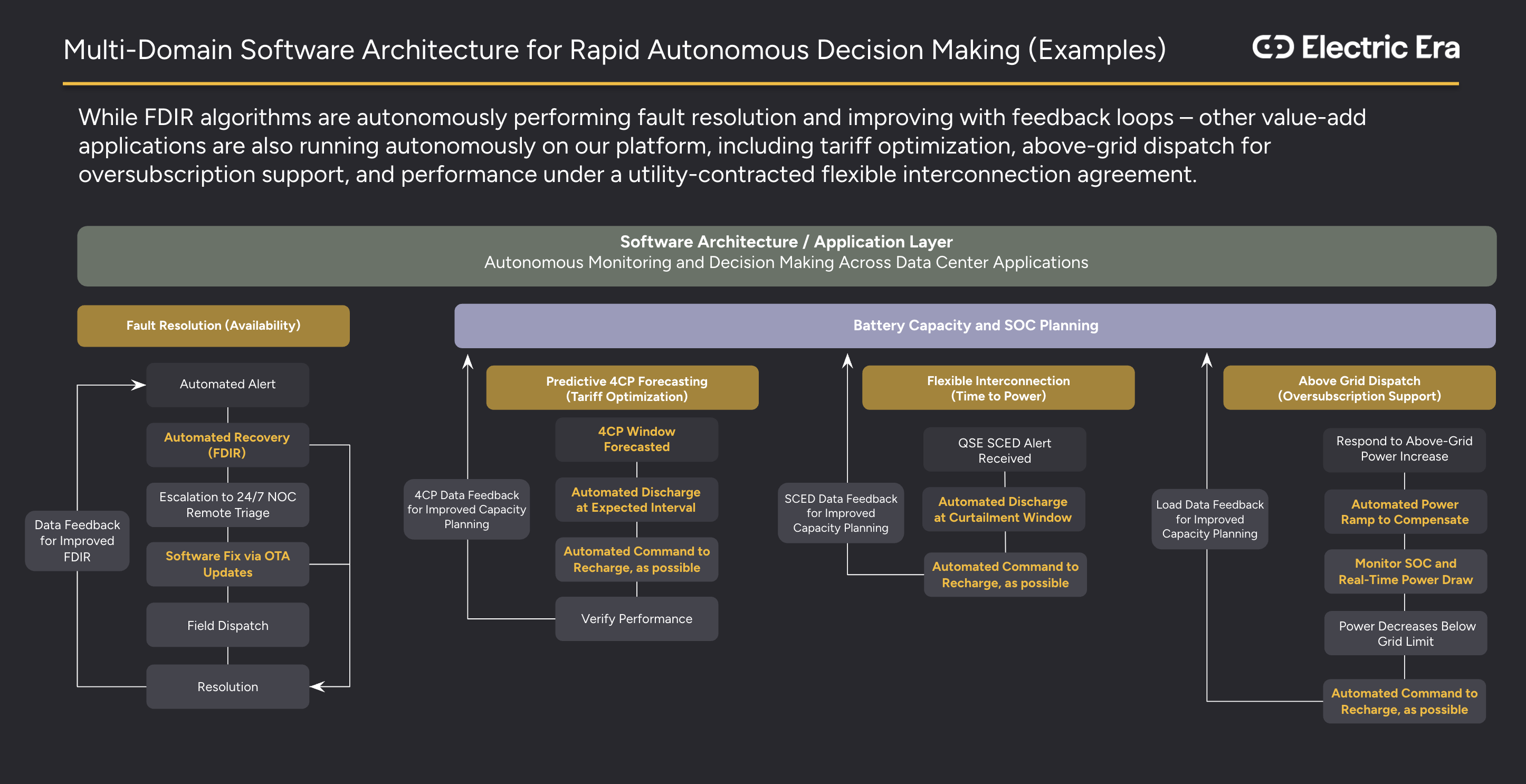
Batteries can be a blunt tool. Electric Era's energy management system—when combined with the battery—adds three things that make maximize cost savings in EV fast charging’s dynamic, peaky load profile:
- Time-of-day limits. Create a schedule lowers the grid limit during the hours when demand is billed at the highest rate.
- Adaptive limits. Create dynamic grid limit logic that adjusts to demand and optimizes costs while also minimizing charging curtailment.
- Battery readiness. The battery recharges off-peak with logic to ensure it is ready to deliver power ahead of anticipated demand.
With Electric Era, every station’s energy management program is designed to optimize costs, while also meeting the instantaneous power demand of more than 99% of charging minutes without capping vehicle charging speed. Drivers get the charging power that their vehicle requests; the utility sees a small, steady load.

Real example: Electric Era customer station
This travel center sits on a remote mountain corridor that travelers use to reach hiking, camping, and ski destinations. It's a critical stop for EV drivers, with few other places to charge for miles. It's also a tough place to make the economics work.
The site faces two main challenges. Peak-hour demand charges run upwards of $28/kW. And traffic is highly seasonal: the summer months (June–September) are nearly four times busier than winter (November–February). Over the year, charger demand reached nearly 400 kW during peak hours and 285 kW off-peak. Yet billed grid demand stayed between 22 and 55 kW every month.
Labor day weekend: Traffic was 79% higher than a typical September day. The Monday of Labor day saw 43 sessions, which peaked at 245 kW. The battery covered 191 kW of that, meaning the grid draw was nice and low.
Slow season: adaptive limits.
With Electric Era’s adaptive grid limit, billed peak demand stayed low through the spring, even though the chargers needed more than 230kW at their busiest times. Without Electric Era’s limits, the site operator would have paid for all of that draw, roughly ten times the demand charges it actually paid. During the busy Memorial Day traffic weekend, the limit rose automatically to adjust for that demand.
The bottom line.
In year one, the site earned $93.7K in charging revenue. After $26.3K in demand charges and $56.3K in energy and other operating costs, it made an $11.1K operating profit. Without the battery, demand charges would have been closer to $105K, turning that profit into a loss of roughly $68K.
The battery and EMS cut demand charges by 75%. Matching that through dilution alone would take a large jump in utilization. Utility cost per kWh delivered fell 60% over the year, from $0.54 to $0.21.
"Battery-backed charging is what makes a site like this work. Electric Era gave us a station that held full charging speeds through our busiest weekend of the year and kept our costs predictable." — EV charging team, leading national travel stop brand
Can battery storage help you avoid costly grid upgrades?
Often, yes. A grid-only station needs a utility connection big enough for every charger running at full power, which can mean a large transformer, long equipment lead times, and a spot in an interconnection queue.
Because the battery covers peaks, a battery-backed station can run on a much smaller connection. At the Colorado site, charger demand reached nearly 400 kW while billed grid demand never went above 55 kW. This delta is often the difference between a 500 kVa service upgrade (pad mounted) and 150 kVa upgrade (pole mounted).
The same approach lets retailers build at power-limited sites while they wait for the utility. In one example, a six-port station at a major retailer served 45 sessions on a Sunday afternoon from a 175 kW grid connection, backed by a 250 kW battery.
Other benefits of battery-backed charging
- Predictable pricing for drivers. With demand charge risk under control, the Colorado operator offers one competitive rate all day, including the busy travel windows when most drivers stop. Another fast charger nearby charges peak rates of $1.33/kWh.
- Reliability drivers come back for. In August and September, as usage peaked, the site ran at 99.9%+ uptime. About a third of vehicles returned for another session, and those repeat visits made up 61% of all sessions.
- Faster deployment. A smaller grid connection means less utility equipment to procure and install.
Explore how Electric Era has helped retailers drive business value with EV fast charging
FAQ:
We run a commercial EV charging station and peak demand charges are hurting us. What can we do?
You can wait for traffic to dilute the charge, negotiate or switch tariffs, or limit how much power the site draws from the grid. A battery-backed system does the third without slowing down drivers, because the battery supplies the power above the grid limit.
How much can battery storage reduce EV charging demand charges?
It depends on the tariff and traffic. At a Colorado travel stop with peak demand charges above $28/kW, battery-backed energy management saved more than $70k in the first year, a 75% mitigation.
Does higher utilization solve the demand charge problem?
It helps, but it doesn't remove the risk. A grid-only site pays close to its full peak from the first busy afternoon, and at high-demand-charge sites that bill can exceed charging revenue. A battery lowers the billed peak itself, so the site is protected through slower seasons and while traffic builds.
Can a battery be added to an existing charging station?
Usually not without major changes. Batteries work best when the chargers, battery, and software are designed to manage power together.
For those weighing EV fast charging ownership, the utility bill is the biggest unknown. Energy costs are fairly predictable. Demand charges aren't, and they can quickly turn a profitable station into an unprofitable one.
This uncertainty makes it difficult to answer critical questions for building and operating a site:
What can you charge drivers?
How long will payback take?
Is my site worth building?
This post explains how demand charges work, why waiting for more traffic to dilute them is a risky plan, and how battery-backed charging changes the math.
What are utility demand charges?
Demand charges are fees utilities bill commercial customers based on peak power (kW) to fund grid infrastructure projects. The utility typically calculates the charge based on the highest 15-minute average draw in the billing month.
Monthly demand charge = $/kW x highest 15-minute kW grid draw
That makes Level 3 fast charging especially exposed. A few vehicles charging upwards of 200 to 400 kW at once can push a site to hundreds of kW for a few minutes. That single window sets the demand charge for the whole month, even if the site is quiet the rest of the time. Many tariffs also price demand by time of day. At one of our customer’s Colorado sites, peak-hour demand costs upwards of $28/kW, compared with about $7/kW the rest of the time. One high-powered session at the wrong moment can set a charge that outpaces everything the site earns that month.
Can't more charging sessions just dilute demand charges?
A common argument we hear is: Once a site sets its monthly peak, the demand charge is fixed. Add more sessions and the same charge spreads over more kWh, so total cost per kWh falls. This is sometimes called demand charge dilution.
As a strategy, this has problems. First, it assumes you're already paying for a full peak. The charge stays flat as sessions grow only because a few cars arriving together have already pushed the site close to its maximum. You're paying the top rate and hoping volume catches up. Two, it puts ramp-up risk on the site. New stations spend their first months seeing lower utilization, so relying on sessions to spread out those costs is risky.
How does battery storage help EV charging avoid peak demand charges?
A grid-only station pulls every kW a vehicle asks for straight from the utility. Whatever drivers do in the busiest 15 minutes of the month sets the bill.
A battery-backed station with energy management software to orchestrate power sources puts a battery energy storage system (BESS) between the chargers and the grid. Software sets a grid limit, a cap on how much power the site may draw from the utility at any moment.
When drivers need more than that cap, the battery covers the difference. The utility only ever sees the capped draw, so billed demand stays tied to a number the operator chooses rather than to when drivers happen to arrive. This is called peak shaving.
Batteries can be a blunt tool. Electric Era's energy management system—when combined with the battery—adds three things that make maximize cost savings in EV fast charging’s dynamic, peaky load profile:
- Time-of-day limits. Create a schedule lowers the grid limit during the hours when demand is billed at the highest rate.
- Adaptive limits. Create dynamic grid limit logic that adjusts to demand and optimizes costs while also minimizing charging curtailment.
- Battery readiness. The battery recharges off-peak with logic to ensure it is ready to deliver power ahead of anticipated demand.
With Electric Era, every station’s energy management program is designed to optimize costs, while also meeting the instantaneous power demand of more than 99% of charging minutes without capping vehicle charging speed. Drivers get the charging power that their vehicle requests; the utility sees a small, steady load.
Real example: Electric Era customer station
This travel center sits on a remote mountain corridor that travelers use to reach hiking, camping, and ski destinations. It's a critical stop for EV drivers, with few other places to charge for miles. It's also a tough place to make the economics work.
The site faces two main challenges. Peak-hour demand charges run upwards of $28/kW. And traffic is highly seasonal: the summer months (June–September) are nearly four times busier than winter (November–February). Over the year, charger demand reached nearly 400 kW during peak hours and 285 kW off-peak. Yet billed grid demand stayed between 22 and 55 kW every month.
Labor day weekend: Traffic was 79% higher than a typical September day. The Monday of Labor day saw 43 sessions, which peaked at 245 kW. The battery covered 191 kW of that, meaning the grid draw was nice and low.
Slow season: adaptive limits.
With Electric Era’s adaptive grid limit, billed peak demand stayed low through the spring, even though the chargers needed more than 230kW at their busiest times. Without Electric Era’s limits, the site operator would have paid for all of that draw, roughly ten times the demand charges it actually paid. During the busy Memorial Day traffic weekend, the limit rose automatically to adjust for that demand.
The bottom line.
In year one, the site earned $93.7K in charging revenue. After $26.3K in demand charges and $56.3K in energy and other operating costs, it made an $11.1K operating profit. Without the battery, demand charges would have been closer to $105K, turning that profit into a loss of roughly $68K.
The battery and EMS cut demand charges by 75%. Matching that through dilution alone would take a large jump in utilization. Utility cost per kWh delivered fell 60% over the year, from $0.54 to $0.21.
"Battery-backed charging is what makes a site like this work. Electric Era gave us a station that held full charging speeds through our busiest weekend of the year and kept our costs predictable." — EV charging team, leading national travel stop brand
Can battery storage help you avoid costly grid upgrades?
Often, yes. A grid-only station needs a utility connection big enough for every charger running at full power, which can mean a large transformer, long equipment lead times, and a spot in an interconnection queue.
Because the battery covers peaks, a battery-backed station can run on a much smaller connection. At the Colorado site, charger demand reached nearly 400 kW while billed grid demand never went above 55 kW. This delta is often the difference between a 500 kVa service upgrade (pad mounted) and 150 kVa upgrade (pole mounted).
The same approach lets retailers build at power-limited sites while they wait for the utility. In one example, a six-port station at a major retailer served 45 sessions on a Sunday afternoon from a 175 kW grid connection, backed by a 250 kW battery.
Other benefits of battery-backed charging
- Predictable pricing for drivers. With demand charge risk under control, the Colorado operator offers one competitive rate all day, including the busy travel windows when most drivers stop. Another fast charger nearby charges peak rates of $1.33/kWh.
- Reliability drivers come back for. In August and September, as usage peaked, the site ran at 99.9%+ uptime. About a third of vehicles returned for another session, and those repeat visits made up 61% of all sessions.
- Faster deployment. A smaller grid connection means less utility equipment to procure and install.
Explore how Electric Era has helped retailers drive business value with EV fast charging
FAQ:
We run a commercial EV charging station and peak demand charges are hurting us. What can we do?
You can wait for traffic to dilute the charge, negotiate or switch tariffs, or limit how much power the site draws from the grid. A battery-backed system does the third without slowing down drivers, because the battery supplies the power above the grid limit.
How much can battery storage reduce EV charging demand charges?
It depends on the tariff and traffic. At a Colorado travel stop with peak demand charges above $28/kW, battery-backed energy management saved more than $70k in the first year, a 75% mitigation.
Does higher utilization solve the demand charge problem?
It helps, but it doesn't remove the risk. A grid-only site pays close to its full peak from the first busy afternoon, and at high-demand-charge sites that bill can exceed charging revenue. A battery lowers the billed peak itself, so the site is protected through slower seasons and while traffic builds.
Can a battery be added to an existing charging station?
Usually not without major changes. Batteries work best when the chargers, battery, and software are designed to manage power together.